AI Agent API: How Developers Are Building Autonomous Applications in 2026
Learn how developers use AI Agent APIs to build autonomous workflows, coding assistants, and business automation systems. Discover the best approach for AI agent development in 2026.
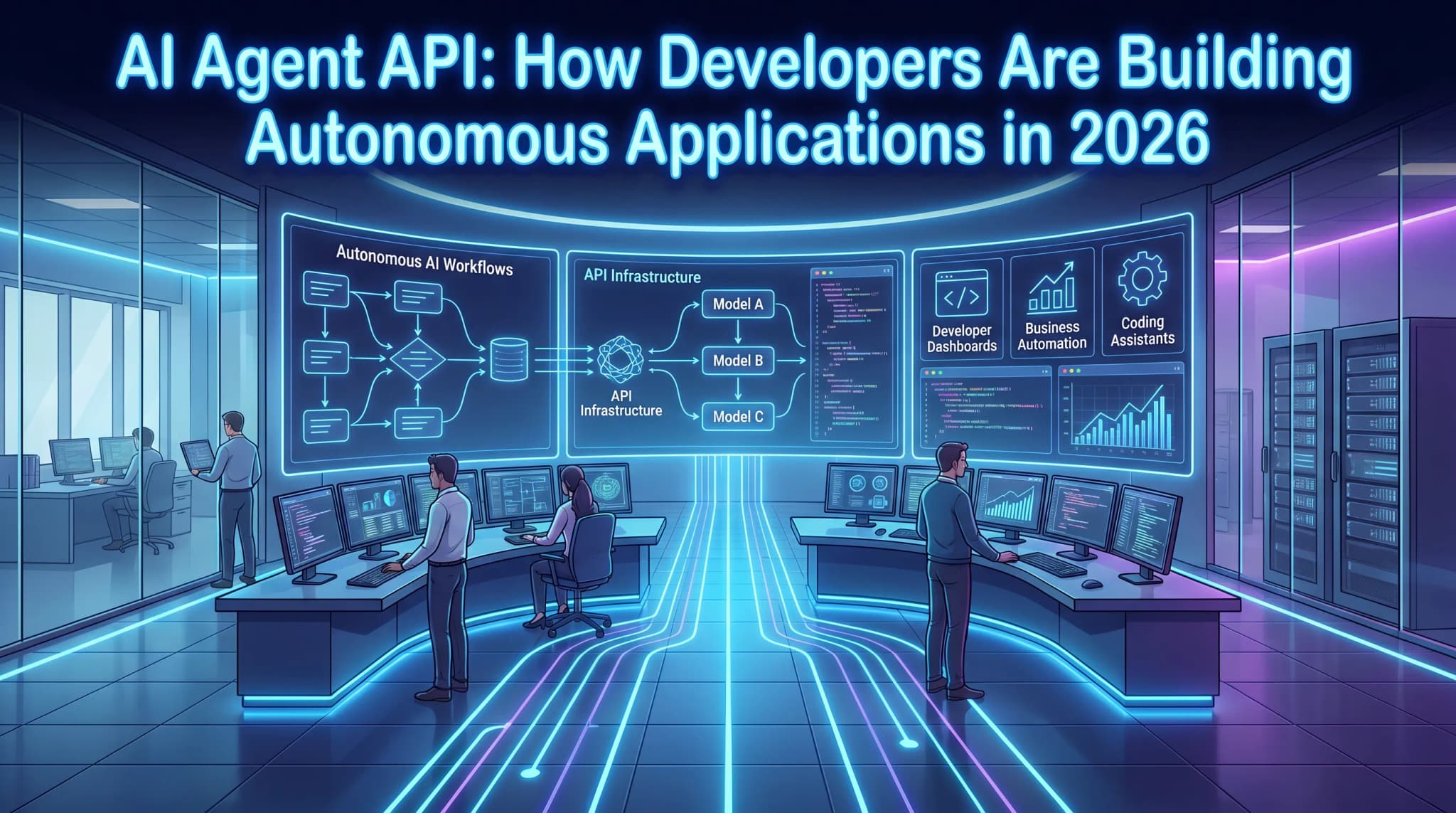
AI agents are rapidly becoming one of the most important trends in software development.
Unlike traditional AI chatbots, AI agents can plan, reason, make decisions, and complete multi-step tasks autonomously.
From coding assistants to business automation systems, AI agents are transforming how companies build software.
As a result, searches related to AI Agent APIs continue to grow as developers look for the best infrastructure to power their applications.
What Is an AI Agent API?
An AI Agent API provides developers with access to large language models that can:
- Understand goals
- Plan actions
- Use tools
- Execute workflows
- Process information
- Generate outputs
Unlike simple chat interfaces, agent systems are designed to perform tasks with minimal human intervention.
Examples include:
- Coding agents
- Research agents
- Customer support agents
- Workflow automation agents
- Internal business assistants
Why AI Agents Are Growing So Fast
Traditional automation systems rely on predefined rules.
AI agents can dynamically adapt to new situations.
For example, an AI agent can:
- Receive a user request
- Analyze requirements
- Select appropriate tools
- Execute tasks
- Deliver results
This creates a much more flexible automation system than traditional workflows.
Major AI companies continue investing heavily in agent technology because it represents the next generation of software interfaces.
Common AI Agent Use Cases
AI Coding Agents
Developers use AI agents to:
- Generate code
- Debug applications
- Review pull requests
- Create documentation
- Refactor code
Customer Support Agents
AI agents can:
- Answer customer questions
- Retrieve information
- Escalate complex issues
- Automate ticket workflows
Research Agents
Research-focused agents help users:
- Gather information
- Summarize content
- Compare sources
- Generate reports
Business Automation Agents
Organizations use AI agents for:
- Internal knowledge systems
- Workflow automation
- Process optimization
- Operational efficiency
What Makes a Good AI Agent API?
Choosing the right AI infrastructure is critical for agent development.
Reliable Reasoning
Agents must make consistent decisions across multiple steps.
Strong Instruction Following
Agent workflows depend on accurate execution.
Long Context Handling
Many tasks require maintaining context over extended interactions.
API Reliability
Production systems need stable APIs and predictable performance.
Why Developers Use Multiple Models for AI Agents
Different AI models excel at different tasks.
| Task | Popular Model Choice |
|---|---|
| Coding | Claude |
| General Reasoning | OpenAI |
| Document Analysis | Gemini |
| Research Workflows | Gemini |
| Business Automation | OpenAI or Claude |
Many development teams now use multiple models to optimize performance and reliability.
The Challenge of Managing Multiple AI Providers
Using multiple providers creates operational complexity.
Developers often need to manage:
- Multiple API keys
- Multiple billing systems
- Different SDKs
- Different documentation
- Separate integrations
As products scale, infrastructure management becomes increasingly difficult.
Why Unified AI APIs Are Becoming Popular
Many teams are moving toward unified AI infrastructure.
Instead of integrating separately with every provider, developers can access multiple AI models through a single API.
Benefits include:
- Faster development
- Simpler maintenance
- Easier experimentation
- Reduced engineering overhead
This approach is especially attractive for startups and SaaS companies building AI agents.
Why Developers Choose OurToken
OurToken AI provides developers with a unified AI API platform that simplifies access to multiple leading AI models through a single integration.
Supported Models
Currently supported:
Developers can choose the best model for coding, reasoning, research, customer support, and AI agent workflows