AI API Gateway vs Direct API: When Is a Gateway Worth It?
AI API gateway vs direct API access: what a gateway does, when it saves money, when it costs more, and a decision checklist for production traffic.
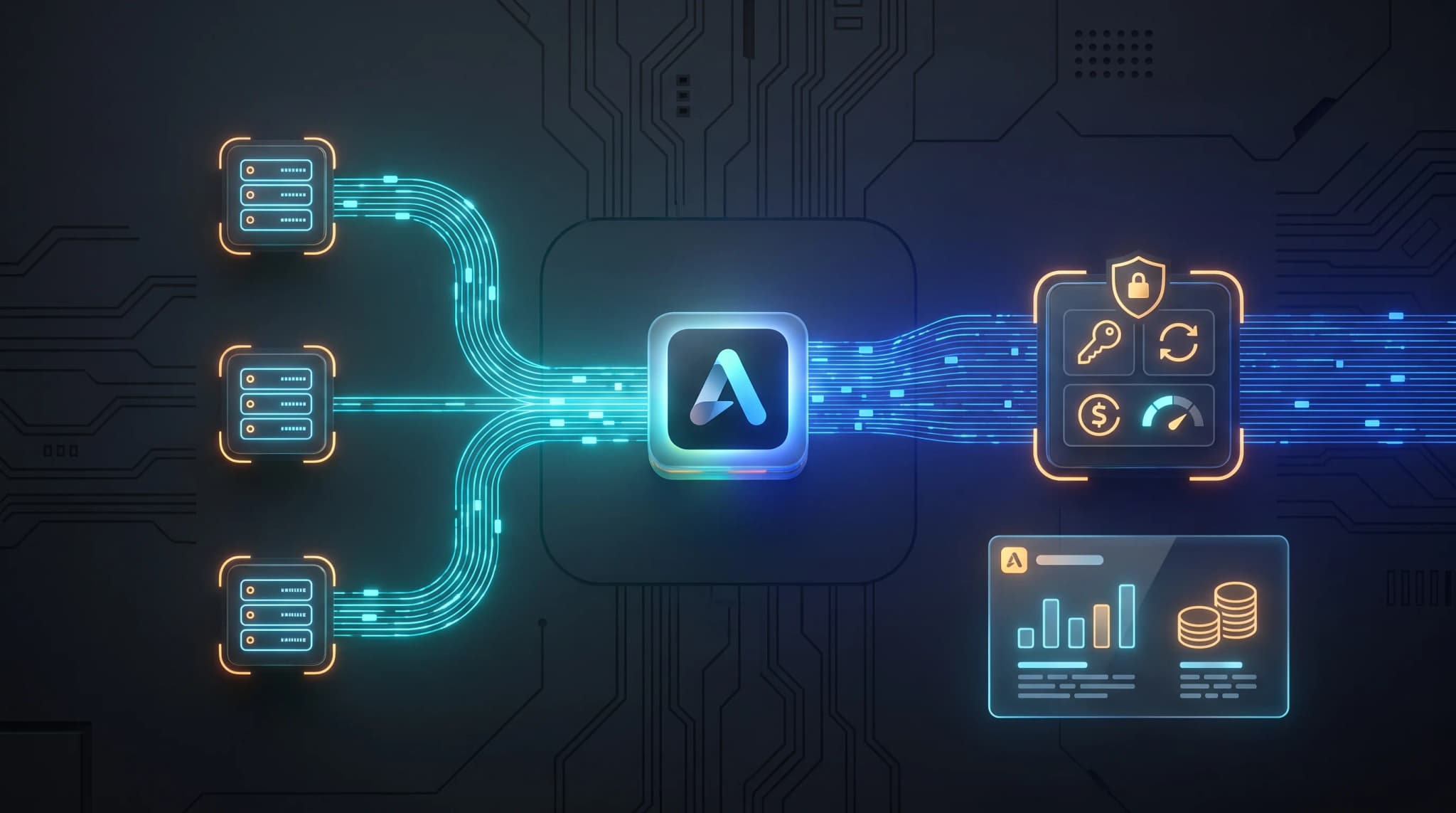
An AI API gateway is a single entry point in front of one or more model providers: your application sends every request to one base URL, and the gateway handles routing, credentials, retries, and billing. Direct API access is the alternative — your application calls each provider (OpenAI, Anthropic, and so on) directly with its own key and its own endpoint. The choice between them is not about which is objectively better; it is about your traffic shape, your team size, and what you are paying for.
This guide compares the two models, lays out exactly what an AI API gateway buys you and what it costs you, and gives a decision checklist you can run against your own workload. It is the decision article that sits between the AI gateway architecture guide (what a gateway is and how to build one) and the API pricing guides (how to budget tokens).
What an AI API Gateway Actually Changes
An AI API gateway does not change which models exist or what they cost per token on the provider side. It changes three operational properties of your integration.
One endpoint and one key instead of N. Direct access means a base URL, a credential, a billing cycle, and a rate limit per provider. A gateway collapses that into a single OpenAI-compatible base URL and a single key. For an application that calls five models from three providers, that is five integrations and three contracts reduced to one. The Claude Code proxy guide shows this concretely: Claude Code's ANTHROPIC_BASE_URL points at a gateway and ANTHROPIC_AUTH_TOKEN replaces the claude.ai login.
Centralized retries, rate limiting, and fallback. Direct access means each integration owns its own retry policy and its own handling of 429s. A gateway can apply one bounded-backoff policy across providers, and it can fall back to a second model when the first is rate-limited. The API rate-limit guide covers the engineering patterns; a gateway is where many teams put them instead of reimplementing them in every service.
One billing surface. Direct access means N dashboards and N invoices. A gateway gives you usage, token counts, and spend in one place, which is what makes cost planning practical instead of a spreadsheet exercise across providers. It also resells the models at its own rates, which can be lower than the provider's — this is where the cost story gets interesting.
The Cost Question: When a Gateway Is Cheaper
The per-token rate is the part most people lead with, and it is the part that depends on who you compare against.
A gateway that resells models at a discount is cheaper than direct access when the provider's list price is your alternative. For example, a gateway route that lists Claude or DeepSeek at 60% of the official reference is unambiguously cheaper than paying the official rate on every token. That is real savings, and for teams already committed to a specific model it is often the simplest cost cut available.
But "cheaper" is not universal. The DeepSeek official vs gateway guide walked through the exact case: DeepSeek's official pricing has off-peak hours at half the peak rate, and a flat 60%-of-reference gateway rate is more expensive than official off-peak pricing. If your workload is a schedulable batch job that can run in off-peak windows, direct access beats the gateway on that specific traffic — not because the gateway is bad, but because the provider runs a time-of-day discount the gateway does not.
The honest framing is this:
| Situation | Cheaper option |
|---|---|
| Paying provider list price on every token | Gateway (if discounted) |
| Workload schedulable into off-peak hours | Direct (provider time-of-day pricing) |
| Cache-heavy traffic on a model with aggressive cache rates | Check both; cache-hit pricing varies by provider |
| Multi-provider traffic, each with its own rate card | Gateway (one rate surface, no per-provider minimums) |
The cost advantage of a gateway is strongest when you are comparing it against list-price direct access. It weakens when a provider runs discounts you can exploit directly — off-peak pricing, batch tiers, or promotional credits — and you can schedule around them.
When a Gateway Costs You More
The flip side is what you give up. These are not hidden fees; they are structural differences that matter for some teams and not others.
Per-token markup on some traffic. A reseller gateway is a middleman. Where the provider offers off-peak or batch discounts that the gateway does not pass through, that traffic is more expensive through the gateway. The OpenAI batch API guide shows the 50%-off batch pattern — if your pipeline is batch-shaped and your gateway does not discount batch, running that pipeline direct is the cheaper route.
Provider-specific features. Some providers expose capabilities a gateway has to whitelist or translate: thinking modes, structured outputs, tool calling, vision inputs. A gateway that has not yet exposed a new provider feature becomes a waiting point. If you need a provider's newest capability the day it ships, direct access is faster. Model routing and tool-calling behavior across providers is covered in the model routing guide.
Compliance and lock-in. A gateway is a third party in the request path. If your policy requires a direct billing relationship with the model provider, or your security team wants the smallest possible surface between your service and the upstream API, direct access is the simpler answer. You are also dependent on the gateway's uptime — if the gateway is down, all providers behind it are down at once.
How to Decide: A Checklist for Your Own Traffic
Do not decide with the comparison table above. Decide with your own traffic, because the right answer is a function of your token mix, your hours, and your team.
- Count providers and models. One model from one provider? Direct access is fine — a gateway's main win (one surface for many) does not apply. Three providers and five models? The gateway consolidates real operational surface.
- Check your peak-hour share. Run your real request timestamps. If most traffic is batchable into off-peak windows, compute the direct off-peak bill and compare it with the gateway rate. Converting token usage into a monthly number is the framework the LLM API pricing guide lays out.
- Measure your cache-hit rate. Pull
prompt_tokens_detailsfrom real responses. Cache-heavy workloads can be cheaper direct if the provider's cache rate beats the gateway's. - Estimate engineering cost. Count the retry logic, rate-limit handling, and fallback code you would write for N direct integrations. If you have no team to own that, a gateway removes the work; if you already have it, the gateway is redundant for that benefit.
- List the features you need at launch. If you need a provider capability the gateway has not exposed, that is a blocker. If everything you need is supported, the gateway is strictly simpler.
- Price the failure modes. A gateway is a single point of failure across providers. If your app cannot tolerate a gateway outage, keep a direct fallback route or accept the risk consciously.
A Practical Middle Ground: Gateway Plus Direct
Most production teams do not have to choose one or the other. The two patterns combine cleanly.
Gateway for interactive and peak traffic. Interactive requests — chat, agents, real-time tools — benefit from the gateway's unified key, retries, and fallback. Peak-hour pricing on a discounted gateway beats list price, and the consolidation is worth it even when the per-token delta is small. This is the traffic the model routing guide assumes: route by cost and quality per request, with the gateway as the front door.
Direct for schedulable batch and off-peak jobs. Overnight batch pipelines that can run at a provider's off-peak or batch rate go direct, where the discount is real and the retry policy is simple. The batch discount pattern — JSONL upload, async processing, roughly half price — is covered in the OpenAI batch API guide.
The two lanes use different credentials and endpoints but the same model IDs, so the application code difference is just which base URL and key it uses for which job. Teams that start on a gateway for everything can later peel the schedulable batch traffic out to direct access once the volumes justify the second integration.
Conclusion
An AI API gateway is worth it when your value comes from consolidation — many models behind one key, one retry and fallback policy, one billing surface, and a discounted rate versus list price. Direct access is worth it when your value comes from exploiting a specific provider's pricing — off-peak hours, batch discounts, or promotional rates — or when compliance and feature-freshness make a middleman unattractive.
Run the checklist against your own token mix rather than picking by reputation. And remember the two can coexist: gateway for interactive traffic, direct for schedulable batch, with the same models and a router deciding which lane each request belongs in.
FAQ
What is an AI API gateway?
A single entry point that receives all your model requests, handles routing, credentials, retries, and billing, and forwards to one or more model providers behind it.
Is a gateway cheaper than direct API access?
It depends. A discounted gateway beats list-price direct access, but direct access can be cheaper when the provider runs off-peak or batch discounts the gateway does not pass through.
When should I use direct API access instead of a gateway?
When you call one model from one provider, when most of your traffic runs in provider off-peak or batch windows, or when compliance requires a direct billing relationship.
Does a gateway add a single point of failure?
Yes. If the gateway is down, all providers behind it are unreachable. Teams that cannot tolerate that keep a direct fallback route or accept the risk.
Do I have to choose one or the other?
No. A common pattern is gateway for interactive traffic and direct access for schedulable batch jobs, with a router deciding which lane each request belongs in.