Why Most AI Agents Fail After 30 Minutes (And How Memory Fixes It)
Many AI agents perform well at first but break down during long workflows. Learn why memory systems have become one of the most important components in modern AI agent architecture.
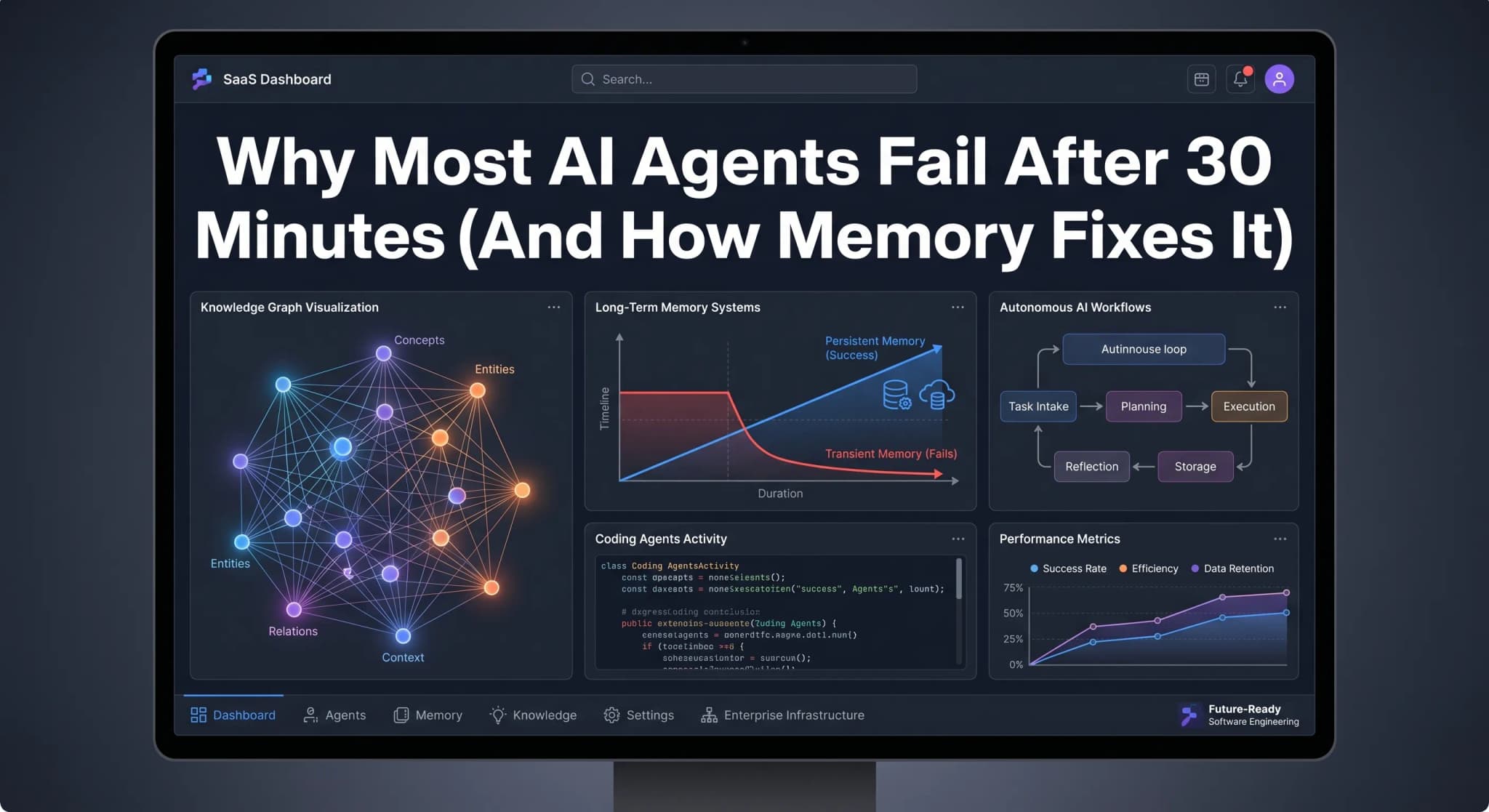
Most AI agents look impressive in demos.
They can:
- Write code
- Search documents
- Generate reports
- Complete simple workflows
But something strange happens when tasks become longer.
Performance starts to degrade.
The agent forgets previous decisions.
Important information disappears.
Workflows become inconsistent.
This is one of the biggest challenges facing AI agent builders today.
The problem is not reasoning.
The problem is memory.
The Hidden Limitation of Modern AI Agents
Most AI agents are built on large language models.
These models are extremely capable.
However, they have one important limitation:
They only know what exists inside the current context window.
Once information falls outside that window, it effectively disappears.
For short conversations this is fine.
For long-running workflows it becomes a major problem.
What Happens When Agents Forget
Imagine an agent helping a software team.
During a six-hour session it may:
- Analyze requirements
- Review documentation
- Read code
- Create implementation plans
- Generate features
- Validate outputs
Without memory, important information gradually disappears.
The result:
- Repeated work
- Inconsistent decisions
- Lower reliability
- Increased token usage
Why Context Windows Are Not Enough
Many people assume larger context windows solve the memory problem.
They help.
But they do not fully solve it.
Even a model with a massive context window eventually faces limits.
Memory and context are not the same thing.
Context
Temporary working space.
Memory
Persistent knowledge that survives across sessions.
The best AI agents use both.
The Three Types of AI Agent Memory
Short-Term Memory
Information from the current task.
Examples:
- User instructions
- Current files
- Recent conversations
Episodic Memory
Past actions and outcomes.
Examples:
- Previous tasks
- Successful workflows
- Failed attempts
Long-Term Memory
Persistent knowledge.
Examples:
- Documentation
- Product requirements
- Customer information
- Internal company knowledge
Why AI Coding Agents Need Memory
Coding agents are becoming increasingly autonomous.
A modern coding agent may work across:
- Hundreds of files
- Multiple repositories
- Long development cycles
Without memory, the agent repeatedly relearns the same information.
This increases cost and reduces reliability.
Memory systems allow agents to build understanding over time.
The New AI Agent Stack
The traditional stack looked like:
User
 ↓
Model
 ↓
Response
Modern agent systems look more like:
User
 ↓
Agent
 ↓
Memory
 ↓
Tools
 ↓
Model
 ↓
Response
Memory has become a core infrastructure layer.
Why Multi-Model Agents Are Emerging
Another trend is the rise of multi-model agents.
Different models perform different jobs.
For example:
| Task | Model Type |
|---|---|
| Planning | Reasoning Model |
| Coding | Coding Model |
| Retrieval | Cost-Efficient Model |
| Long Context | Large Context Model |
This architecture allows developers to optimize performance and cost simultaneously.
Why Developers Choose OurToken
As AI agent systems become more complex, teams increasingly need access to multiple model families.
OurToken AI provides a unified OpenAI-compatible API that supports:
This allows developers to experiment with different agent architectures without managing multiple provider integrations.
The Future of AI Agents
The next generation of AI agents will not win because they have better prompts.
They will win because they remember more.
Memory systems are rapidly becoming one of the most important competitive advantages in AI development.
Over the next few years, agent memory may become as important as the language model itself.
Frequently Asked Questions
What is AI agent memory?
AI agent memory allows an agent to retain information across tasks, workflows, and sessions.
Why do AI agents forget?
Most language models only have access to information inside their current context window.
Is a larger context window the same as memory?
No. Context is temporary. Memory is persistent.
Why is memory important for coding agents?
Memory helps coding agents maintain consistency across long development workflows.
Which models are available through OurToken?
OurToken currently supports OpenAI, Claude, DeepSeek, GLM, and MiniMax model families.
Final Thoughts
Many developers focus on models.
The next breakthrough may come from memory.
As AI agents become more autonomous, the ability to remember, retrieve, and apply information over long periods will become increasingly important.
The future of AI agents is not just better reasoning.
It's better memory.