OpenAI API Alternative: Switch Without Rewriting Your App
Use OurToken as an OpenAI API alternative: change one base URL and model ID, keep your SDK, and compare GPT-5.6, GPT-6 Astra, and Claude pricing.
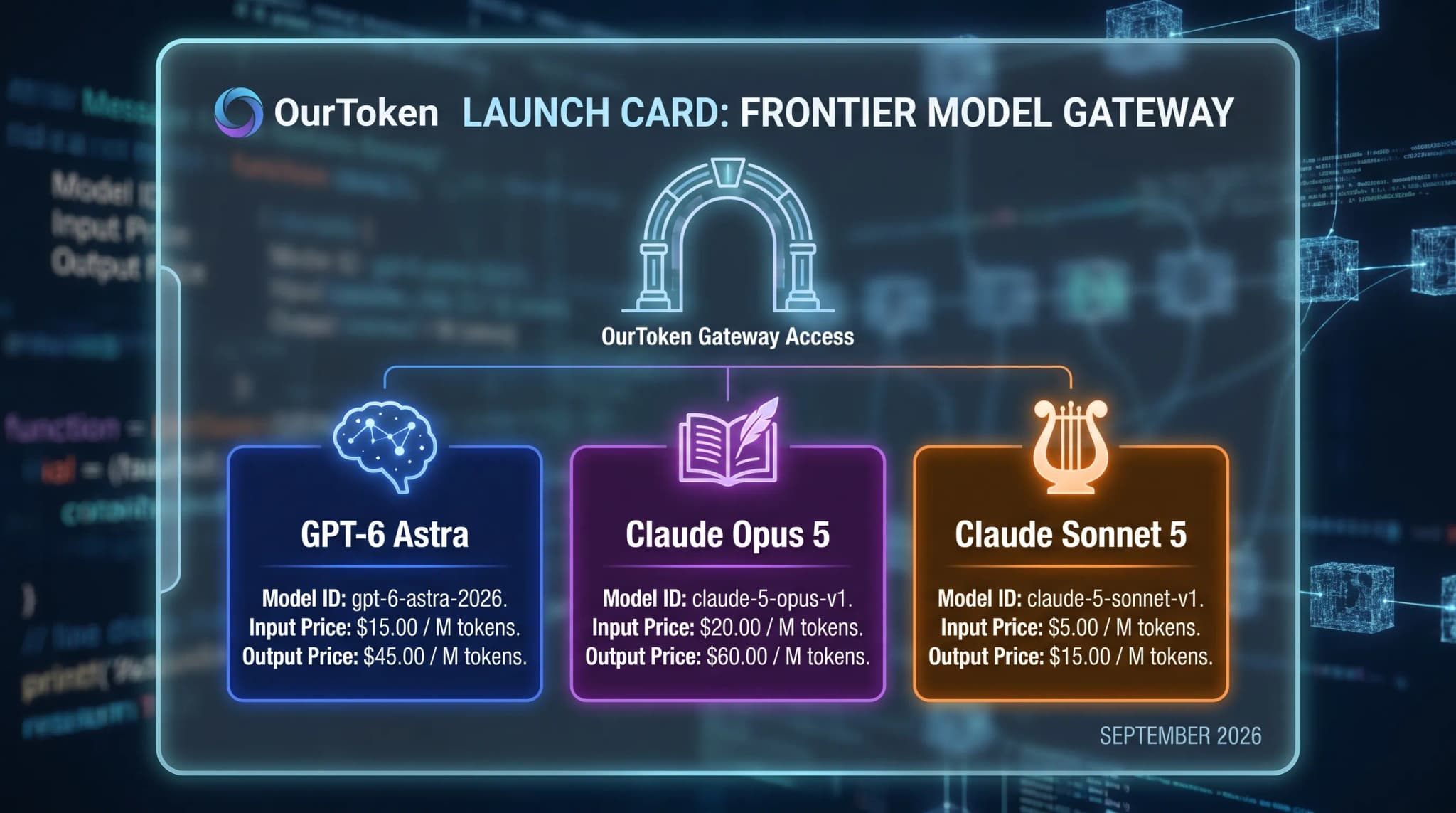
An OpenAI API alternative becomes practical when it keeps your client shape intact and changes only the endpoint, credential, and model ID. That is the core difference between a compatible gateway and a rewrite project: if your app already talks to the OpenAI Responses API, the smallest useful alternative preserves that request structure and lets you point the SDK at a different base URL.
On OurToken, the OpenAI-compatible route is:
Base URL:  https://api.ourtoken.ai/v1
Endpoint:  https://api.ourtoken.ai/v1/responses
Auth:      Authorization: Bearer YOUR_API_KEY
In Python, the first move is often as small as this:
import os
from openai import OpenAI

client = OpenAI(
    api_key=os.environ["OURTOKEN_API_KEY"],
    base_url="https://api.ourtoken.ai/v1",
)

response = client.responses.create(
    model="gpt-5.6-terra",
    input="Summarize this incident report in three bullets.",
    max_output_tokens=256,
)
The rest of this guide treats "alternative" as an engineering decision, not a slogan. It explains when a compatible endpoint is the right fit, how the migration works, what you gain by routing across GPT-5.6, GPT-6 Astra, and Claude 5, and how to measure the result with real token math.
Verification status: The model IDs, context limits, endpoint paths, and prices below were checked against live OurToken model pages on 2026-09-14. OpenAI-family prices are 20% of the official comparison prices shown on those pages; Claude 5 prices are 40%. Confirm the live pages before committing production traffic.
Why Developers Look for an OpenAI API Alternative
The search for an alternative usually starts with one of three pressures: spend, capacity, or model choice. The useful question is not "which provider has a different name?" but "which path lets me change providers without increasing integration risk?"
Cost pressure without a rewrite
Most teams do not want a new API design. They want lower marginal cost for the same calls. If a provider speaks the OpenAI wire format, an existing application can usually preserve its prompt templates, response parser, tool schema, streaming loop, and retry logic. The integration surface shrinks to configuration:
OpenAI-hosted route:
  base_url: https://api.openai.com/v1
  key:      OPENAI_API_KEY

OurToken route:
  base_url: https://api.ourtoken.ai/v1
  key:      OURTOKEN_API_KEY
That does not mean every parameter has identical semantics on every model route. A compatible base URL is the beginning of compatibility, not proof of it. You still test tool calls, structured output, multimodal input, response format, streaming events, and usage fields before you move production.
Model choice and failover
A second motivation is access to more than one frontier family. A single
provider key is easy to reason about until a route is rate-limited, a model
is over capacity, or a workload outgrows the model. With one compatible
surface, the model field becomes a routing decision:
gpt-5.6-lunafor high-volume extraction, routing, and classification.gpt-5.6-terrafor balanced production work.gpt-5.6-solfor difficult reasoning, coding, and tool chains.gpt-6-astrafor frontier work that needs a very large context window.- Claude Sonnet 5 or Opus 5 for agentic work where the Claude request shape is preferable.
This is where the alternative path becomes architecture. The fallback logic does not need five provider SDKs and five auth systems. OpenAI-compatible routes share one client configuration, while Claude routes use a Messages-compatible shape documented below.
Evaluation against your own workload
Benchmark tables are useful for narrowing candidates, but they do not answer whether a model can follow your schema, resist your edge cases, or keep latency stable under your real payload sizes. The right alternative is the one that survives your replay set: production prompts with PII removed, typical tool traces, malformed inputs, long context, and the error paths your service already handles.
For background on this design, the OpenAI-compatible API explainer describes how a compatible endpoint keeps the wire format while changing the route behind it. The AI API migration guide covers provider-by-provider mapping in more depth.
Pricing Comparison: GPT-5.6, GPT-6 Astra, and Claude 5
The prices below are verified from the live model pages on 2026-09-14. The "official" columns are the official comparison prices shown on those pages; the OurToken columns are the effective per-million-token rates.
| Model | Model ID | Context / max output | OurToken input | OurToken output | Official input | Official output | Ratio |
|---|---|---|---|---|---|---|---|
| GPT-5.6 Luna | gpt-5.6-luna | 250K / 128K | $0.04 | $0.24 | $0.20 | $1.20 | 20% |
| GPT-5.6 Terra | gpt-5.6-terra | 250K / 128K | $0.40 | $2.40 | $2.00 | $12.00 | 20% |
| GPT-5.6 Sol | gpt-5.6-sol | 250K / 128K | $1.00 | $6.00 | $5.00 | $30.00 | 20% |
| GPT-6 Astra | gpt-6-astra | 1,050K / 128K | $2.00 | $10.00 | $10.00 | $50.00 | 20% |
| Claude Sonnet 5 | claude-sonnet-5 | 1M / 128K | $0.80 | $4.00 | $2.00 | $10.00 | 40% |
| Claude Opus 5 | claude-opus-5 | 1M / 128K | $2.00 | $10.00 | $5.00 | $25.00 | 40% |
GPT-5.6 and GPT-6 Astra use OurToken's OpenAI-compatible Responses endpoint. Claude Sonnet 5 and Opus 5 use a Messages-compatible endpoint, so they are part of the same platform and key model, but they are not a one-line OpenAI Responses swap. We cover both request shapes below.
The GPT-5.6 family also has separate cache prices. Sol is $0.10 per million cached input tokens and $1.25 per million cache writes. Terra is $0.04 cached input and $0.50 cache writes. Luna is $0.004 cached input and $0.05 cache writes. For repeated system prompts, those rates can matter more than the headline input price; the OpenAI-compatible prompt caching guide shows how to identify cacheable prefixes and measure the effect.
Translate rates into a monthly decision
Percent discounts are easy to misread. A per-request model is clearer. Assume a support triage job sends 2,000 input tokens and produces 300 output tokens.
Luna:
  input:  2,000 / 1,000,000 x $0.04 = $0.000080
  output:   300 / 1,000,000 x $0.24 = $0.000072
  total:                               $0.000152

Terra:
  input:  2,000 / 1,000,000 x $0.40 = $0.000800
  output:   300 / 1,000,000 x $2.40 = $0.000720
  total:                               $0.001520
At 400,000 requests per month, the Luna route is about $60.80 and Terra is about $608.00. That does not make Terra wrong; it means the workload needs a quality threshold. If Luna misses 2% of tickets that Terra handles cleanly, a human review queue may cost more than the extra $547.20.
Now add routing:
- 80% of simple tickets: 320,000 x $0.000152 = $48.64.
- 20% of hard tickets: 80,000 x $0.001520 = $121.60.
- Routed total: $170.24.
The routed design costs about 28% of a full Terra month while preserving a higher-capability path for the 20% where quality justifies it.
Cache-aware example
Suppose Terra serves 120,000 requests per month. Each request sends 4,000 input tokens: 2,400 are a cached system and product-context prefix, and 1,600 are fresh ticket data. Output is 600 tokens.
Fresh input:  1,600 / 1,000,000 x $0.40 = $0.000640
Cache read:   2,400 / 1,000,000 x $0.04 = $0.000096
Output:         600 / 1,000,000 x $2.40 = $0.001440
Total:                                     $0.002176
Monthly:      120,000 x $0.002176          = $261.12
If all 4,000 input tokens were billed as fresh, the monthly total would be
$364.80. The cached-prefix route above is $261.12, saving $103.68 per month.
The exact benefit depends on cache-hit
stability, prompt-prefix design, and whether the route reports cached tokens,
so log the usage object rather than assuming a fixed hit rate.
Compatibility and Switching
Compatibility and Switching
Compatibility, Migration, and Multi-Model Routing
What "OpenAI-Compatible" Does and Does Not Mean
A compatible endpoint is a promise about the request shape, not a guarantee that every feature flag, parameter alias, or billing detail behaves the same. Treat it like an adapter boundary.
Usually preserved
- Authentication with a bearer credential.
- The
/v1base URL and/responsespath for OpenAI routes. - Text input as a string or structured message array.
max_output_tokensas the output budget.- Output items and usage data in the response.
- Streaming, when the selected route supports it.
Verify on your route
- Exact model IDs. Use
gpt-5.6-terra, notgpt 5.6 Terraorgpt-5.6.terra. - Tool definitions and tool-call output placement.
- Structured output support and JSON validation behavior.
- Image or file input limits.
- Streaming event names and retry semantics after a disconnect.
- Reasoning controls, effort levels, and token accounting.
- Error payloads for 400, 401, 404, 413, and 429 cases.
The safest way to document this is a compatibility matrix in your repo. List every feature the application actually uses, then mark each model route as supported, unsupported, or needs a wrapper. That one table turns a provider discussion into a checklist.
Switch an OpenAI Python Client in Four Steps
This is a production-shaped migration, not a hello-world. The sequence keeps one variable per test so failures are easy to attribute.
1.
Install the official OpenAI Python SDK,
which implements the responses.create interface used below. Keep the key in
a server-side environment variable.
python -m pip install --upgrade openai
export OURTOKEN_API_KEY="paste-your-key-locally"
import os
from openai import OpenAI

client = OpenAI(
    api_key=os.environ["OURTOKEN_API_KEY"],
    base_url="https://api.ourtoken.ai/v1",
)
In PowerShell, use:
$env:OURTOKEN_API_KEY = "paste-your-key-locally"
Do not put the key in browser JavaScript, mobile code, a public notebook, or a repository. If a key may have leaked, rotate it and remove it from logs and incident history.
2. Send a minimal Responses API request
Start with Terra and a short output budget. This proves authentication, model routing, and response parsing before you add tools or a long context.
response = client.responses.create(
    model="gpt-5.6-terra",
    input=[
        {"role": "system", "content": "Answer in concise production notes."},
        {"role": "user", "content": "Review this database migration plan for rollback risks."},
    ],
    max_output_tokens=256,
)

print(response.model)
print(response.output_text)
print(response.usage)
A healthy first response gives you four facts: the selected model ID, the visible output, the input and output token counts, and the latency observed by your client. Record all four on the first successful call. The OpenAI Responses API guide is useful for the request concepts, while the selected model page is the compatibility boundary for OurToken's route.
3. Run the same request with cURL
An SDK can hide path construction, retry behavior, and headers. A direct HTTP request makes them explicit.
curl -sS https://api.ourtoken.ai/v1/responses \
  -H "Content-Type: application/json" \
  -H "Authorization: Bearer ${OURTOKEN_API_KEY}" \
  -d '{
    "model": "gpt-5.6-terra",
    "input": "Give me a two-step rollback checklist.",
    "max_output_tokens": 256
  }'
If cURL works but the SDK fails, inspect the client's path joining, auth header, timeout, and response parser. If cURL fails first, debug the key, endpoint, model ID, or payload before touching application code.
4. Compare models without changing the parser
For OpenAI-compatible routes, evaluation is mostly a loop over model IDs:
PROMPTS = [
    "Classify the customer intent as billing, bug, or feature request.",
    "Extract company, owner, amount, and due date as JSON.",
    "Explain the likely root cause in three bullets.",
]

for model in ["gpt-5.6-luna", "gpt-5.6-terra", "gpt-5.6-sol"]:
    for prompt in PROMPTS:
        response = client.responses.create(
            model=model,
            input=prompt,
            max_output_tokens=256,
        )
        print(model, response.usage, len(response.output_text))
A useful comparison captures task success, schema validity, reviewer-approved quality, time to first byte, total latency, input tokens, output tokens, cached tokens, and estimated cost. Change only the model field between runs. The GPT-5.6 API cost calculator is a companion for turning those counts into monthly estimates.
Multi-Model Routing
Multi-Model Routing and Troubleshooting
Add Claude Routes Without Losing the Architecture
Claude Sonnet 5 and Claude Opus 5 can sit behind the same OurToken key, but they use a different wire shape. The Claude route is:
Base URL:  https://api.ourtoken.ai/v1
Endpoint:  https://api.ourtoken.ai/v1/messages
Auth:      Authorization: Bearer YOUR_API_KEY
The request follows the public
Anthropic Messages API reference:
system is a top-level field, max_tokens is required, and the response has
typed content blocks. A minimal HTTP request looks like this:
curl -sS https://api.ourtoken.ai/v1/messages \
  -H "Content-Type: application/json" \
  -H "Authorization: Bearer ${OURTOKEN_API_KEY}" \
  -d '{
    "model": "claude-sonnet-5",
    "max_tokens": 512,
    "system": "You are a concise engineering assistant.",
    "messages": [
      {"role": "user", "content": "Plan a safe rollout for a schema change."}
    ]
  }'
The architecture lesson is to keep two small adapters behind one internal interface:
Your service interface
  complete(task, messages, tools, budget)
        |
        +-- OpenAIResponsesAdapter -> /v1/responses
        |       model: gpt-5.6-luna | terra | sol | gpt-6-astra
        |
        +-- ClaudeMessagesAdapter -> /v1/messages
                model: claude-sonnet-5 | claude-opus-5
The rest of the application does not need to know which adapter ran. It sees one normalized result containing text, tool calls, usage, model ID, latency, and error metadata. This pattern is particularly useful when you want Claude for an agentic workflow but Luna or Terra for pre-processing, routing, and cheap summarization.
Model Fallback and Routing Architecture
A fallback is not a blind retry. Blind retries can duplicate side effects and increase cost without changing the outcome. A useful router separates retry conditions from model alternatives.
Request
  |
  +--> Parse and validate input
  |      |
  |      +--> Reject malformed input before spending tokens
  |
  +--> Select primary route by task class and budget
  |
  +--> Call model with timeout, request ID, and token cap
  |
  +--> Success?
        |
        +--> yes: normalize response and log usage
        |
        +--> no:
             429/5xx/timeout -> bounded backoff on same model
             unsupported feature -> switch compatible route
             quality policy -> escalate to stronger model
             repeated failure -> queue for human review
Here is a compact Python router for OpenAI-compatible routes:
import time
from openai import APIConnectionError, APIStatusError, APITimeoutError

MODEL_ROUTES = [
    "gpt-5.6-luna",
    "gpt-5.6-terra",
    "gpt-5.6-sol",
]

def should_retry(exc):
    if isinstance(exc, (APIConnectionError, APITimeoutError)):
        return True
    if isinstance(exc, APIStatusError):
        return exc.status_code in RETRYABLE_STATUSES
    return False

def complete_with_fallback(client, prompt, max_output_tokens=512):
    last_error = None

    def should_retry(exc):
        if isinstance(exc, (APIConnectionError, APITimeoutError)):
            return True
        if isinstance(exc, APIStatusError):
            return exc.status_code in {408, 409, 425, 429, 500, 502, 503, 504, 529}
        return False

    for route in MODEL_ROUTES:
        for attempt in range(3):
            try:
                response = client.responses.create(
                    model=route,
                    input=prompt,
                    max_output_tokens=max_output_tokens,
                )
                return {
                    "route": route,
                    "attempts": attempt + 1,
                    "output_text": response.output_text,
                    "usage": response.usage.model_dump(),
                }
            except (APIConnectionError, APITimeoutError, APIStatusError) as exc:
                last_error = exc
                if not should_retry(exc):
                    raise
                sleep_for = 0.5 * (2**attempt)
                print({"route": route, "attempt": attempt + 1, "retry_in": sleep_for})
                time.sleep(sleep_for)

    raise RuntimeError("All model routes failed") from last_error
In production, tune this retry policy for your gateway, add a per-request deadline, and include a stable request ID. If a model call triggers a tool that changes external state, ensure the tool operation is idempotent before retrying the full chain. The OpenAI-compatible tool calling guide covers the request and response details for tool-aware routes.
For many workloads, policy-based escalation beats failover alone. A router can send routine extraction to Luna, standard assistant turns to Terra, and only promote ambiguous cases to Sol or Astra after a confidence check. That keeps the average cost close to the cheap model while retaining a high-quality escape hatch.
Real Scenario: A Support Automation Team
A four-person product team runs support triage for 400,000 monthly tickets. The first request classifies intent and extracts order metadata. The second generates a policy-constrained draft from those fields. The team initially considered one premium model for every ticket.
The token profile is representative rather than universal:
- Ticket text plus retrieved help-center context: 2,000 input tokens.
- Draft plus citations: 300 output tokens.
- Stable support policy prefix: cacheable in steady state.
- 80% of tickets are routine billing, shipping, or password issues.
- 20% involve refunds, chargebacks, or multi-system troubleshooting.
Without routing, the Terra calculation above puts the month at roughly $608.00. A Luna-only route drops it to about $60.80, but QA finds that Luna needs clearer policy constraints and occasionally misses a chargeback nuance.
The chosen design uses Luna for classification and metadata extraction, Terra for drafting routine replies, and Sol for the hardest 20% only after policy keywords or a confidence score indicate escalation. A weekly evaluation run holds back 500 real tickets and compares schema validity, policy violations, agent edits, and token cost.
| Route | Requests | Per request | Monthly |
|---|---|---|---|
| Luna classification/extraction | 400,000 | $0.000152 | $60.80 |
| Terra routine drafts | 320,000 | $0.001520 | $486.40 |
| Sol escalated drafts | 80,000 | $0.003800 | $304.00 |
| Combined | — | — | $851.20 |
The table makes the tradeoff uncomfortable and useful: adding Sol raises cost above the all-Terra plan. The team therefore tightens the escalation rule so that only 40,000 tickets reach Sol:
Luna:            400,000 x $0.000152 = $60.80
Terra:           360,000 x $0.001520 = $547.20
Sol:              40,000 x $0.003800 = $152.00
Routed total:                         $760.00
That is still above all-Terra on these token assumptions, so the final policy depends on measured quality. If Sol cuts agent edits enough to recover more than $152 of support time, it wins. If not, Terra remains the default and Sol becomes a weekly sample for difficult-case evaluation. The arithmetic does not replace judgment; it makes the judgment auditable.
The implementation stays boring on purpose. One secret, two adapter modules, one policy table, and logs containing model ID, request ID, token counts, cache status, latency, and escalation reason. The team can defend every dollar because each route has its own count.
Troubleshooting an Alternative Endpoint Migration
Most migration failures fall into six categories. Check them in order.
| Symptom | Likely cause | Fix |
|---|---|---|
| 401 unauthorized | Missing Authorization: Bearer, wrong key, or whitespace | Use the OurToken key with a raw Bearer header; SDKs add Bearer themselves |
| 404 not found | Wrong base URL, missing /v1, or wrong operation path | OpenAI routes use /v1/responses; Claude uses /v1/messages |
model_not_found | Display name, catalog path, or wrong punctuation used as model ID | Copy gpt-5.6-terra, gpt-6-astra, or claude-sonnet-5 exactly |
| 400 unsupported parameter | Official feature used on an unsupported route | Start with model, input, and output limit; add fields one at a time |
| Incomplete output | Output budget consumed by reasoning or long output | Raise max_output_tokens, reduce input, or lower reasoning effort where supported |
| 429 or timeout | Concurrency, long prompt, or short client timeout | Use bounded backoff, cap retries, and check client and gateway timeouts |
If usage fields are missing, do not estimate production cost from intuition. Run the smallest possible request, inspect the raw response, and confirm whether cached input tokens are reported on the selected route. Keep one canonical log schema so the same fields survive SDK, HTTP, and queue-worker paths.
Security checks belong in the same runbook:
- Store keys in a server-side secret manager.
- Rotate keys after employee offboarding or suspected exposure.
- Redact prompts and completions before adding them to support tickets.
- Log error classes, not full credentials or customer payloads.
- Cap output tokens and retries so a failure cannot become a bill.
Conclusion
A good OpenAI API alternative does not ask you to forget your current application. It preserves the OpenAI-compatible request surface where that fits, exposes exact model IDs, and makes provider choice a routing decision rather than a rewrite. OurToken's GPT-5.6 and GPT-6 Astra routes use the Responses endpoint with one key, while Claude 5 routes add a Messages adapter when the workflow calls for Anthropic-style execution.
The decision should come down to measured compatibility and arithmetic: replay real prompts, validate tool and schema behavior, log usage from the first request, then compare Luna, Terra, Sol, Astra, and Claude on the tasks that justify their price. When you are ready to test, create a key from the OurToken API Keys page and run the Terra smoke test before changing your production router.
FAQ
What is the best OpenAI API alternative?
The best alternative is the one that preserves the API surface you already
use and passes your own evaluation set. For an existing OpenAI Responses API
app, a compatible endpoint such as https://api.ourtoken.ai/v1 minimizes
code changes. For Claude-heavy agentic work, add a Messages-compatible
adapter instead of pretending both wire formats are identical.
Can I keep my OpenAI Python SDK?
Yes. Set base_url="https://api.ourtoken.ai/v1", use an OurToken key, and
call client.responses.create() with an exact model ID such as
gpt-5.6-terra. Test every parameter your application uses, because
compatibility is determined per route, not assumed from the base URL alone.
What endpoint does OurToken use for OpenAI models?
The OpenAI-compatible Responses endpoint is
https://api.ourtoken.ai/v1/responses, with the SDK base URL set to
https://api.ourtoken.ai/v1. The request authenticates with
Authorization: Bearer YOUR_API_KEY.
Is GPT-5.6 cheaper on OurToken?
The live GPT-5.6 Luna, Terra, and Sol model pages list OurToken rates at 20% of the official comparison prices shown on those pages. As of 2026-09-14, Terra is $0.40 per million input tokens and $2.40 per million output tokens. Confirm the current page before finalizing a budget.
Is this an OpenRouter alternative?
It can function as an OpenRouter alternative for teams that want one multi-model endpoint and transparent model pricing. The practical test is the same: check whether your SDK, tools, streaming loop, structured outputs, and model IDs work without an adapter, then compare token cost and latency on your own traffic.
Can I use one key for GPT-5.6, GPT-6 Astra, and Claude 5?
One OurToken key can authenticate all of those routes, but OpenAI-compatible
and Claude-compatible requests use different paths. GPT-5.6 and Astra use
/v1/responses; Claude Sonnet 5 and Opus 5 use /v1/messages.
How do I choose between Luna, Terra, Sol, and GPT-6 Astra?
Start with task risk and token volume. Use Luna for high-volume routine classification, Terra for balanced production work, Sol for difficult reasoning and coding, and Astra when frontier capability or the 1,050K-token context window justifies the higher rate. Validate the choice on your own prompts, not on a single benchmark.
What should I log during the first week?
Log model ID, endpoint, request ID, status, latency, input tokens, output tokens, cached input tokens when available, retry count, escalation reason, and estimated cost. This is enough to detect quality regressions, runaway routes, and unexpected cache behavior before the first invoice.