What Is an OpenAI-Compatible API? And Why More Developers Are Switching in 2026
Learn what an OpenAI-compatible API is, why developers are adopting OpenAI-compatible infrastructure, and how to switch AI providers without rewriting your application.
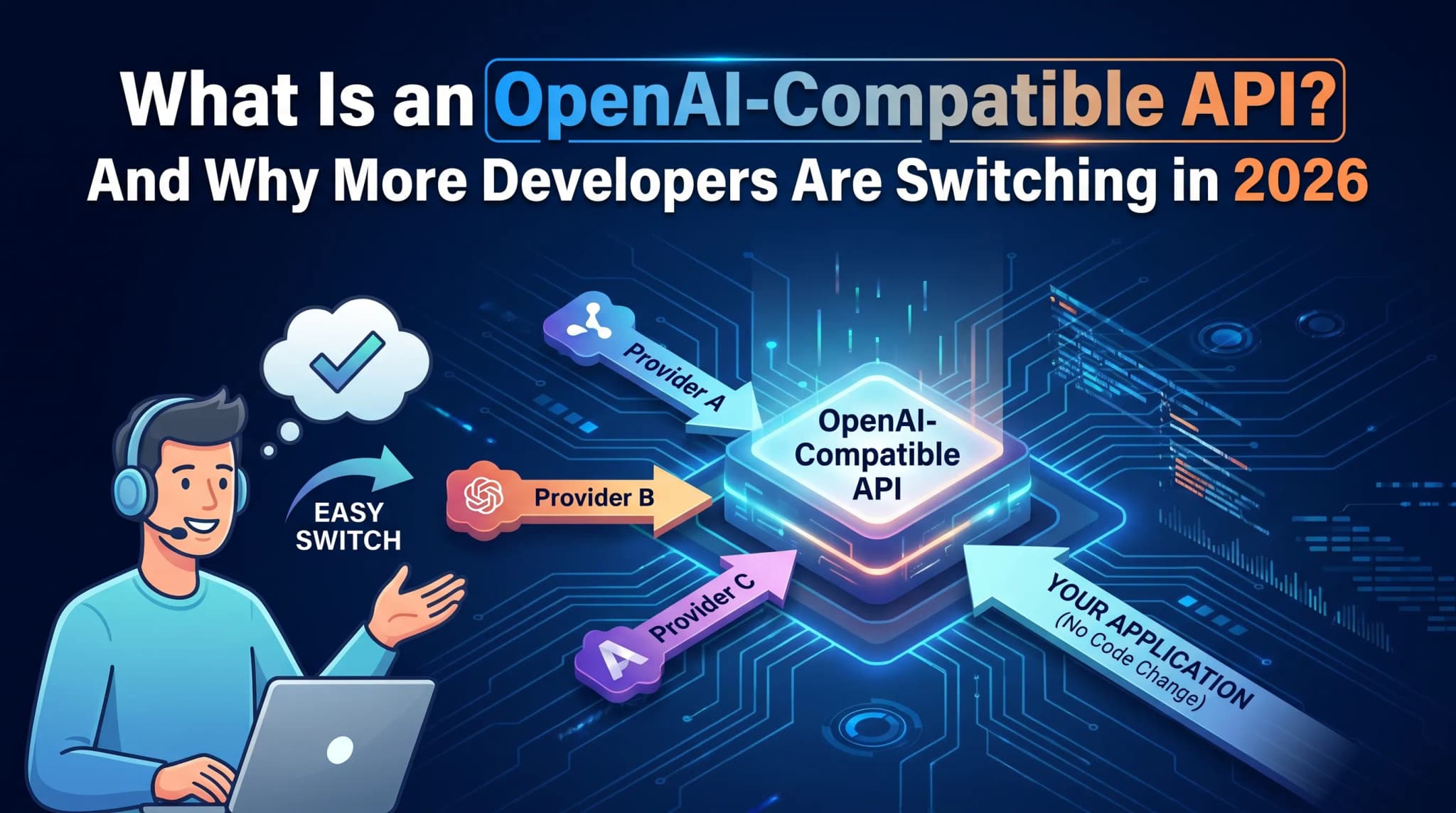
The AI ecosystem is evolving faster than ever.
New models launch every month.
Pricing changes frequently.
Performance leaders shift constantly.
For developers, this creates an important challenge:
How can you adopt better AI models without rebuilding your application every time the market changes?
This is one of the main reasons OpenAI-compatible APIs have become increasingly popular.
Instead of locking your application to a single AI provider, OpenAI-compatible APIs allow you to build on a familiar standard while maintaining the flexibility to switch providers and models when needed.
For startups, AI products, SaaS applications, and AI agents, this flexibility can save significant engineering time and reduce infrastructure complexity.
What Is an OpenAI-Compatible API?
An OpenAI-compatible API follows the same request and response format used by OpenAI's API.
This means developers can continue using:
- Existing SDKs
- Existing application logic
- Existing integrations
- Existing development workflows
without major modifications.
For example, many applications already use patterns similar to:
client.chat.completions.create(
    model="model-name",
    messages=[...]
)
With an OpenAI-compatible API, developers often only need to change:
- API endpoint
- API key
- Model name
instead of rewriting large portions of their application.
Why Developers Are Moving Beyond Single-Provider Architectures
A few years ago, using a single AI provider was usually enough.
Today, the AI landscape looks very different.
Developers increasingly want access to:
- OpenAI models
- Anthropic Claude models
- DeepSeek models
- GLM models
- MiniMax models
Each model family has different strengths.
| Workload | Popular Model Choice |
|---|---|
| General Reasoning | GPT Models |
| AI Agents | Claude Models |
| Long Context Tasks | GLM Models |
| Cost Optimization | DeepSeek Models |
| High-Volume Applications | MiniMax Models |
As products become more sophisticated, developers often need access to multiple model ecosystems.
The Hidden Cost of Provider Lock-In
One of the biggest risks in modern AI development is provider lock-in.
When your application depends entirely on a single provider:
- Migration becomes difficult
- Cost optimization becomes limited
- Reliability risks increase
- New model adoption becomes slower
Imagine a new model launches tomorrow that performs better and costs less.
If your infrastructure is tightly coupled to a single provider, switching may require significant engineering effort.
OpenAI-compatible APIs help reduce that risk.
How OpenAI-Compatible APIs Simplify Development
OpenAI-compatible infrastructure allows developers to standardize their integrations.
Benefits include:
Faster Model Adoption
Evaluate and deploy new models quickly.
Reduced Engineering Work
Reuse existing SDKs and integrations.
Easier Cost Optimization
Choose the most cost-effective model for each workload.
More Flexibility
Experiment with different providers without rebuilding applications.
Why Multi-Model AI Is Becoming the New Standard
The question used to be:
Which AI model should we use?
Modern teams increasingly ask:
Which model should we use for this specific task?
Example:
| Task | Model |
|---|---|
| Coding | Claude |
| General Chat | GPT |
| Long Documents | GLM |
| High-Volume Processing | DeepSeek |
| Budget-Sensitive Tasks | MiniMax |
This approach often improves:
- Quality
- Reliability
- Cost Efficiency
at the same time.
OpenAI-Compatible APIs and AI Agents
AI agents are becoming one of the fastest-growing categories in software development.
Modern agents often need:
- Planning
- Tool Calling
- Memory
- Retrieval
- Execution
Different stages of an agent workflow may benefit from different models.
OpenAI-compatible APIs make experimentation significantly easier.
Developers can test multiple models without redesigning their entire architecture.
This flexibility is becoming increasingly important as agent systems become more complex.
Why Developers Choose OurToken
OurToken provides a unified OpenAI-compatible API that allows developers to access multiple AI model ecosystems through a single integration.
Supported Model Families
OpenAI Models
https://ourtoken.ai/models/openai
Anthropic Claude Models
https://ourtoken.ai/models/anthropic
DeepSeek Models
https://ourtoken.ai/models/deepseek
GLM Models
https://ourtoken.ai/models/glm
MiniMax Models
https://ourtoken.ai/models/minimax
Documentation
Key Benefits
- OpenAI-Compatible API
- Unified Billing
- Single Integration
- Prepaid Credits
- Pay-As-You-Go Usage
- Access to Multiple AI Providers
Instead of managing multiple provider accounts, developers can work through a single platform.
How to Switch AI Providers Without Rewriting Your Application
In many cases, migration is simpler than developers expect.
A common process looks like this:
Step 1
Keep your existing OpenAI SDK integration.
Step 2
Update the API endpoint.
Step 3
Update authentication credentials.
Step 4
Select a new model.
Step 5
Test and compare outputs.
For many applications, migration can be completed with minimal code changes.
Frequently Asked Questions
What is an OpenAI-compatible API?
An OpenAI-compatible API follows the same request and response format used by OpenAI, making it easier to reuse existing integrations.
Why are developers adopting OpenAI-compatible APIs?
They simplify migrations, reduce engineering effort, and provide flexibility when adopting new models.
Can I switch AI providers without rewriting my application?
In many cases, yes. OpenAI-compatible infrastructure allows developers to reuse existing SDKs and workflows.
Why do startups use multiple AI models?
Different models offer different strengths in pricing, reasoning, context length, and performance.
Does OurToken provide an OpenAI-compatible API?
Yes.
OurToken provides OpenAI-compatible access to:
- OpenAI
- Claude
- DeepSeek
- GLM
- MiniMax
through a unified API platform.
Final Thoughts
The AI industry changes too quickly to build around a single provider forever.
Developers increasingly need flexibility.
OpenAI-compatible APIs provide a practical way to:
- Reduce vendor lock-in
- Adopt new models faster
- Optimize infrastructure costs
- Simplify development workflows
As AI applications become more sophisticated, compatibility and flexibility may become just as important as model quality itself.
The future of AI development is not choosing one provider.
It's building infrastructure that allows you to choose the best provider whenever you need to.