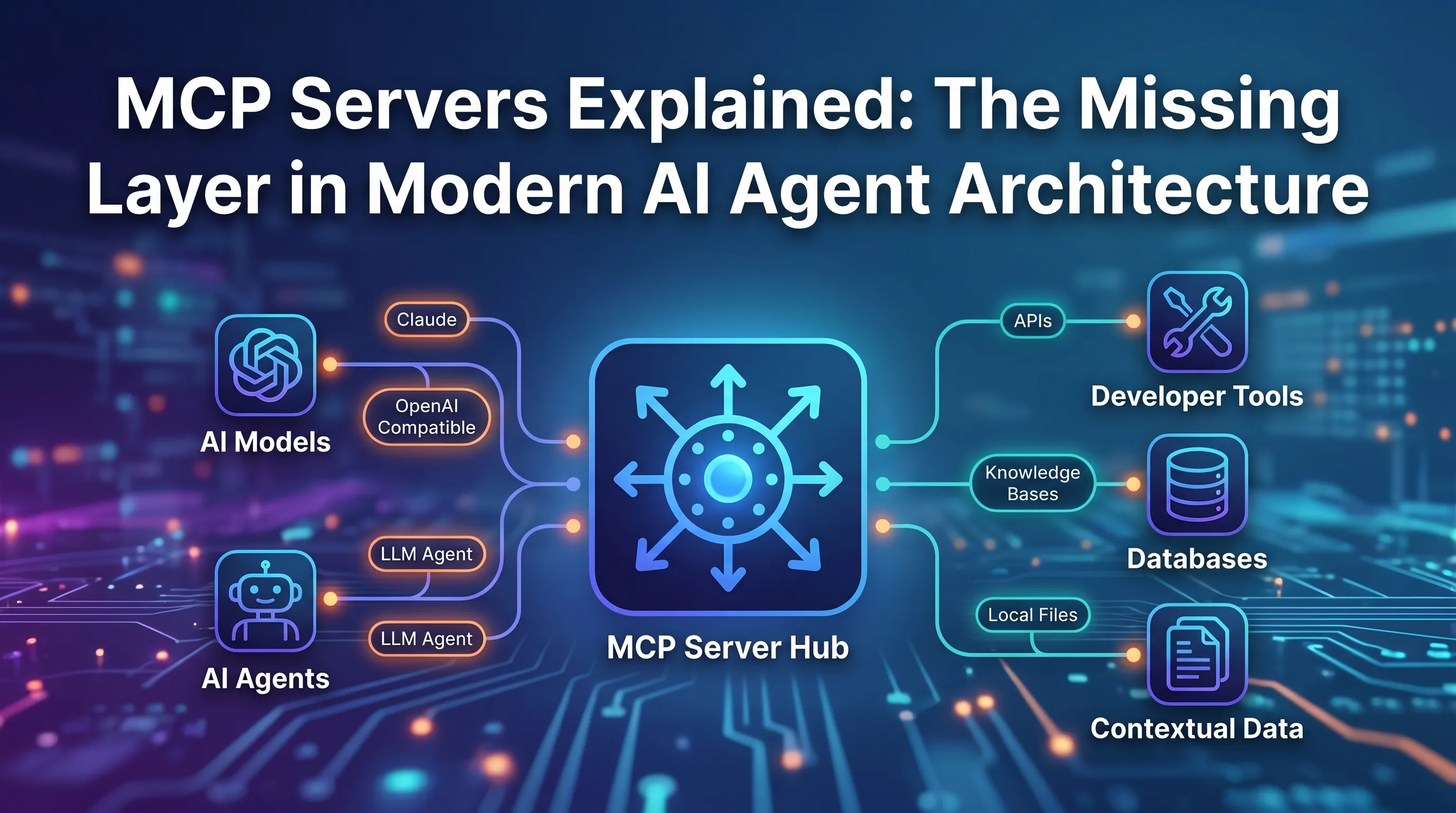
MCP Servers Explained: The Missing Layer in Modern AI Agent Architecture
Learn what MCP (Model Context Protocol) servers are, how they work, and why they're becoming essential infrastructure for AI agents, Claude, OpenAI-compatible systems, and modern developer workflows.
AI agents are becoming more capable every month.
They can:
- Write code
- Search documents
- Query databases
- Use external tools
- Execute workflows
But as AI systems become more powerful, a new challenge has emerged:
How should models securely connect to tools and data?
This is where MCP Servers enter the picture.
Over the past year, Model Context Protocol (MCP) has rapidly become one of the most discussed topics among developers building AI agents, coding assistants, and autonomous workflows.
Many engineers believe MCP may become as important to AI agents as HTTP became to the web.
What Is an MCP Server?
MCP stands for:
Model Context Protocol
The protocol was introduced to create a standard way for AI models to interact with external systems.
Instead of creating custom integrations for every tool, developers can expose functionality through MCP servers.
Think of MCP as:
AI Model
    ↓
MCP Server
    ↓
Tools / APIs / Databases
The model communicates with a standardized interface rather than dozens of custom implementations.
Why AI Agents Need MCP
Early AI agents typically relied on:
- Custom APIs
- Tool-specific integrations
- Hardcoded workflows
This created significant complexity.
Every new tool required:
- New code
- New maintenance
- New authentication logic
MCP introduces a common interface.
Benefits include:
- Faster development
- Better interoperability
- Easier maintenance
- More reusable tooling
MCP vs Traditional APIs
Many developers ask:
Isn't MCP just another API?
Not exactly.
Traditional APIs are designed for applications.
MCP is designed specifically for AI models.
| Feature | Traditional API | MCP Server |
|---|---|---|
| Human Developer Focus | Yes | No |
| AI Agent Focus | Limited | Yes |
| Tool Discovery | Manual | Native |
| Context Sharing | Limited | Built-In |
| Standardized Tool Access | No | Yes |
This distinction is why MCP is attracting so much attention.
How MCP Servers Work
A typical MCP workflow looks like:
User
 ↓
AI Agent
 ↓
MCP Server
 ↓
Database / API / Tool
 ↓
Response
The AI model can:
- Discover available tools
- Understand capabilities
- Execute actions
- Retrieve data
without requiring custom integrations for every system.
MCP and AI Coding Agents
One area where MCP adoption is growing rapidly is AI coding.
Coding agents often need access to:
- Git repositories
- Documentation
- Terminal commands
- File systems
- Databases
Without MCP:
Every integration becomes a custom project.
With MCP:
Tools can expose a common interface that multiple AI systems can understand.
MCP and Multi-Agent Systems
The next generation of AI products will likely involve multiple agents working together.
Examples include:
- Planning Agents
- Coding Agents
- Testing Agents
- Research Agents
MCP provides a shared communication layer that allows these systems to interact with external tools consistently.
Why Infrastructure Matters More Than Models
Many teams spend most of their time comparing models.
Examples include:
Model quality matters.
But infrastructure increasingly determines long-term success.
The teams that build scalable architectures often outperform teams simply using the latest model.
OpenAI-Compatible APIs and the Future of AI Infrastructure
As AI stacks become more complex, developers increasingly want:
- Model flexibility
- Cost optimization
- Unified infrastructure
Platforms such as:
allow developers to access multiple model ecosystems through a single OpenAI-compatible API.
Useful resources:
- https://ourtoken.ai/models
- https://ourtoken.ai/models/glm/glm-5-2
- https://ourtoken.ai/models/anthropic/claude-opus-4-8
- https://ourtoken.ai/docs
This allows teams to build MCP-enabled systems while maintaining access to multiple leading model providers.
Frequently Asked Questions
What is MCP?
MCP stands for Model Context Protocol.
It provides a standard way for AI models to interact with tools and external systems.
What is an MCP Server?
An MCP Server exposes tools, APIs, or data sources through the MCP protocol.
Why are developers adopting MCP?
MCP reduces integration complexity and improves interoperability between AI systems and external tools.
Is MCP replacing APIs?
No.
MCP complements APIs by providing an AI-focused interaction layer.
Why is MCP important for AI agents?
AI agents rely heavily on tools and external systems.
MCP standardizes those interactions.
Final Thoughts
The AI industry spent the last two years focused on models.
The next wave of innovation may come from infrastructure.
MCP Servers are quickly becoming one of the most important building blocks for AI agents, coding assistants, and autonomous systems.
Understanding MCP today may provide a significant advantage as AI architectures continue to evolve.