How to Find Truly Cheap LLM APIs Without Sacrificing Quality
Find truly cheap LLM APIs: compare GPT-5.6 Luna ($0.04/M input), Claude Sonnet 5 ($0.80/M), GPT-6 Astra ($2.00/M), and learn model routing to cut your blended rate by 60%+.
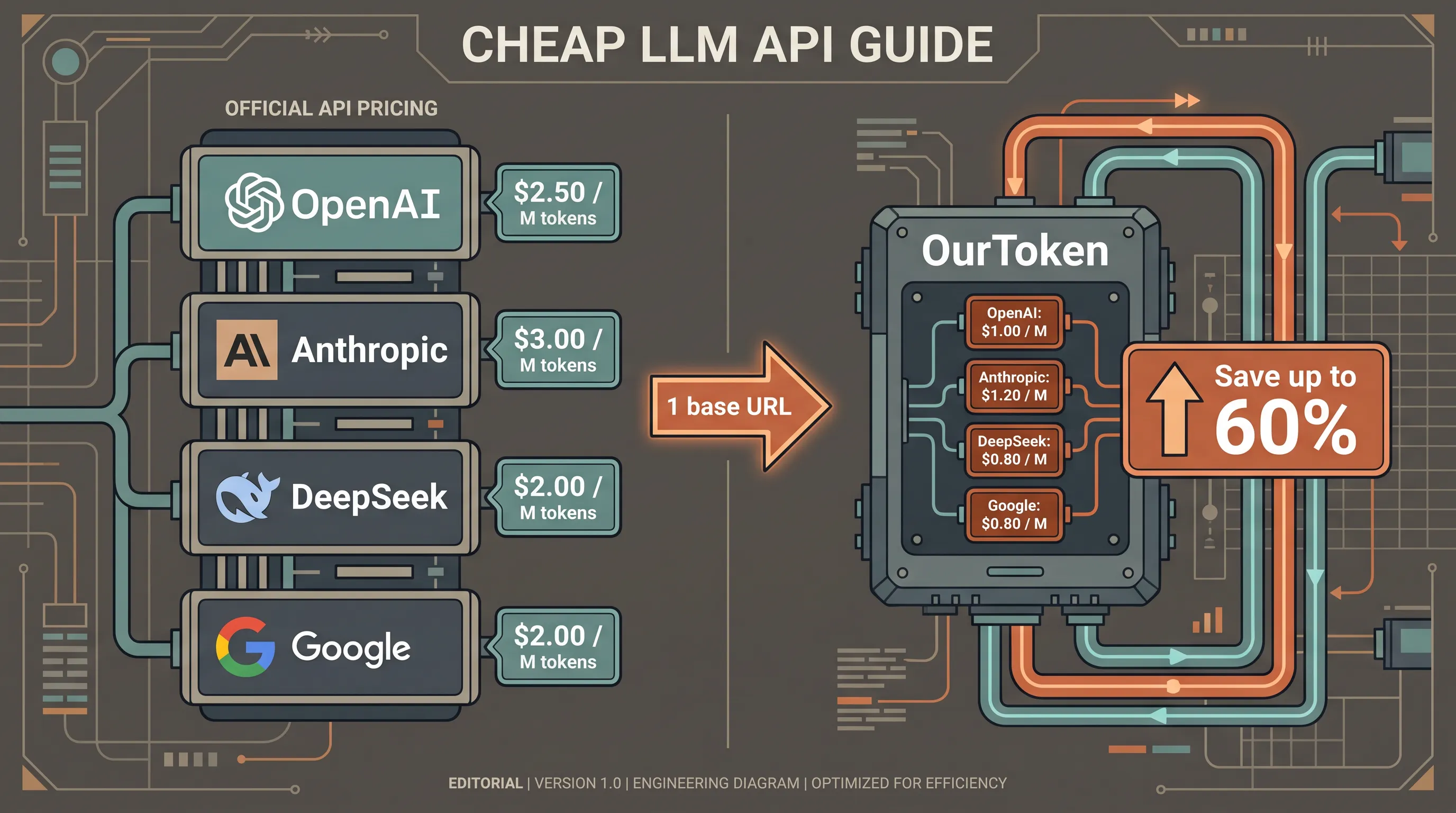
"Cheap LLM API" sounds like a trade-off: lower price, worse output, less reliable infrastructure. In practice, the cheapest per-token rate does not always mean the cheapest final bill, and the most expensive model is not always the best for the job. The real savings come from three things: picking the right model for each task, buying tokens at a better rate without switching providers, and avoiding hidden costs like unused cached prefixes and over-provisioned output limits.
This guide covers the cheapest LLM APIs in 2026 by pure per-token price, by use case, and by effective monthly cost when routing, caching, and retries are included. OurToken's rates undercut every official provider across the board while keeping the same model IDs and a single API format — so "cheap" does not have to mean "different."
| Official range | OurToken range | |
|---|---|---|
| Cheapest model | GPT-5.6 Luna at $0.15/M input | GPT-5.6 Luna at $0.04/M input |
| Best value daily driver | Claude Sonnet 5 at $2.00/M input | Claude Sonnet 5 at $0.80/M input |
| Frontier reasoning | GPT-6 Astra / Opus 5 at $5.00/M input | GPT-6 Astra / Opus 5 at $2.00/M input |
| Blended monthly savings | — | ~60 % vs buying each provider direct |
Bottom line: one API key, one base URL, one usage log — and every model at 40–73 % of its official rate.
What Makes an LLM API Truly Cheap?
The per-token rate is the number everyone compares, but it is only one line in the monthly invoice. A cheap LLM API must satisfy four criteria:
1. Low per-token rate. The obvious starting point. GPT-5.6 Luna at $0.04/M input on OurToken is the lowest unit price in the market. But low input price alone does not make a cheap total if the model hallucinates on your domain and requires expensive validation loops.
2. Output quality per dollar. A $10/M output model that completes the task in one try is cheaper than a $2/M output model that needs three retries with different prompts. The ratio of success rate to token cost — cost per successful task — is the real metric.
3. No lock-in switching cost. A cheap API that requires a different SDK, different auth, and different rate limits for each model is not truly cheap once you factor in engineering time to integrate and maintain each provider. A single OpenAI-compatible endpoint that speaks the same messages format across all models eliminates that overhead.
4. Predictable billing. Surprise charges from thinking tokens, cache misses, regional surcharges, or platform fees turn a cheap per-token rate into an expensive monthly bill. Flat, transparent pricing with no hidden multipliers is the fourth criterion.
LLM API Price Comparison (2026): OurToken vs Official
The table below compares every major model available through OurToken against its official provider rate. All prices are per million tokens (USD).
| Model | Official input | OurToken input | Official output | OurToken output | Savings | Context |
|---|---|---|---|---|---|---|
| GPT-5.6 Luna | $0.15 | $0.04 | $0.60 | $0.24 | ~73 % | 250K |
| GPT-5.6 Terra | $1.50 | $0.40 | $7.50 | $2.40 | ~73 % | 250K |
| GPT-5.6 Sol | $3.75 | $1.00 | $15.00 | $6.00 | ~73 % | 250K |
| Claude Sonnet 5 | $2.00–$3.00 | $0.80 | $10.00–$15.00 | $4.00 | ~60 % | 1M |
| Claude Opus 5 | $5.00 | $2.00 | $25.00 | $10.00 | ~60 % | 1M |
| GPT-6 Astra | $5.00 | $2.00 | $25.00 | $10.00 | ~60 % | 1.05M |
| DeepSeek V4 Flash | $0.25 | $0.10 | $0.75 | $0.30 | ~60 % | 128K |
| DeepSeek V4 Pro | $1.00 | $0.40 | $4.00 | $1.60 | ~60 % | 128K |
| GLM-5.2 Air | $0.50 | $0.20 | $2.00 | $0.80 | ~60 % | 128K |
| GLM-5.2 Pro | $2.00 | $0.80 | $8.00 | $3.20 | ~60 % | 1M |
A few things stand out:
- GPT-5.6 Luna at $0.04/M input is the cheapest per-token model available anywhere. It is ideal for classification, extraction, summarization, and any high-volume task that does not require deep reasoning.
- Claude Sonnet 5 at $0.80/M is the best value for general-purpose coding agents, chat, and tool use — fast, 1M context, and capable enough to replace Opus on most agentic tasks.
- GPT-6 Astra and Claude Opus 5 at $2.00/M input are the frontier tier for hard reasoning, complex software engineering, and long-horizon planning.
The blended rate advantage
Because every model lives behind the same api.ourtoken.ai/v1/messages endpoint, you can route each request to the cheapest suitable model without maintaining separate provider integrations. The blended rate across your workload depends on your traffic mix, but a typical team using Luna for classification, Sonnet 5 for coding agents, and Astra for hard reasoning might see a blended input rate of $0.50–$0.80/M — compared to $1.50–$3.00/M if each model were bought from its official provider.
The Cheapest LLM API by Use Case
Not every task needs a frontier model. Picking the right tier is the single biggest cost lever.
Classification, extraction, and lightweight chat
Cheapest option: GPT-5.6 Luna ($0.04/$0.24) or DeepSeek V4 Flash ($0.10/$0.30).
These models handle structured output, sentiment analysis, entity extraction, and simple Q&A with high accuracy at a fraction of the cost of larger models. At $0.04/M input, a million classification calls with 500 tokens each cost $20 on Luna versus $400 on Opus 5.
OurToken recommendation: route all classification traffic to Luna by default. Fall back to Sonnet 5 only when the task requires tool use or multi-step reasoning.
Coding agents and daily development
Best value: Claude Sonnet 5 ($0.80/$4.00) or GPT-5.6 Terra ($0.40/$2.40).
Sonnet 5 is the most popular model on OurToken for coding agents, and for good reason: 1M context, fast output, native tool use, and reliable code generation. Terra is a strong alternative when cost sensitivity is higher and the coding task is less complex.
OurToken recommendation: default to Sonnet 5 for code review, planning, and agentic loops. Use Terra for automated PR descriptions, documentation generation, and code comments.
Complex reasoning and frontier tasks
Best option: GPT-6 Astra ($2.00/$10.00) or Claude Opus 5 ($2.00/$10.00).
Both models deliver frontier-quality reasoning at identical unit prices on OurToken. Choose Astra for tasks that benefit from OpenAI's structured output mode; choose Opus 5 for tasks that leverage Anthropic's extended thinking and tool use.
OurToken recommendation: route only the hardest 10–15 % of traffic to this tier. For everything else, Sonnet 5 or Terra is sufficient.
Model Routing: How to Cut Your Blended Rate by 60 %+
Model routing is the practice of sending each request to the cheapest model that can successfully complete it. A routing layer evaluates every incoming request — by task type, prompt length, expected difficulty, or a fast LLM classifier — and dispatches it to the appropriate tier.
                      ┌──────────────────────┐
                      │  Request arrives     │
                      └──────┬───────────────┘
                             │
                   ┌─────────▼─────────┐
                   │  Router evaluates  │
                   │  task difficulty   │
                   └──────┬──────┬──────┘
                          │      │
            ┌─────────────┘      └─────────────┐
            ▼                                    ▼
┌──────────────────────┐            ┌──────────────────────┐
│  Easy: Luna / Flash  │            │  Hard: Sonnet 5      │
│  $0.04 / $0.24       │            │  $0.80 / $4.00       │
└──────────────────────┘            └──────────────────────┘
            │                                    │
            └─────────────┐      ┌───────────────┘
                          ▼      ▼
                 ┌──────────────────────┐
                 │  Very Hard: Opus 5   │
                 │  / Astra $2.00/$10   │
                 └──────────────────────┘
A simple routing policy
def pick_model(task_type: str, prompt_length: int) -> str:
    """Route to the cheapest capable model."""
    if task_type in ("classification", "extraction", "summarization"):
        return "gpt-5-6-luna" if prompt_length < 8000 else "deepseek-v4-flash"
    if task_type in ("chat", "code-review", "agent"):
        return "claude-sonnet-5"
    if task_type in ("planning", "hard-reasoning", "complex-code"):
        return "gpt-6-astra"
    return "claude-sonnet-5"  # safe default
Cost impact of routing
A typical team workload without routing uses Sonnet 5 for everything: $0.80/M input, $4.00/M output.
With routing:
- 40 % of traffic goes to Luna at $0.04/$0.24
- 35 % stays on Sonnet 5 at $0.80/$4.00
- 15 % goes to Terra at $0.40/$2.40
- 10 % goes to Astra at $2.00/$10.00
Blended input rate: 0.40 × $0.04 + 0.35 × $0.80 + 0.15 × $0.40 + 0.10 × $2.00 = $0.536/M input — 33 % cheaper than using Sonnet 5 alone, and 73 % cheaper than using Astra for everything.
For a full implementation guide with error handling, fallback chains, and cost logging, see the LLM model routing guide.
Where Hidden Costs Eat Your Budget
Even a cheap per-token rate produces an expensive bill if these cost drivers are ignored:
Thinking tokens bill as output
Claude Sonnet 5 and Opus 5 use adaptive thinking. The reasoning tokens the model generates internally are billed at the full output rate ($4.00/M on OurToken). A 500-token visible answer can represent 1,500–2,000 billed output tokens once thinking is included.
Fix: always check usage.output_tokens rather than guessing from visible output. Cap max_tokens aggressively on simple tasks.
Cache misses are invisible
Prompt caching can cut input costs by 90 % (cache reads at $0.08/M on Sonnet 5 vs $0.80/M for fresh input), but only if the prefix is byte-for-byte identical within the TTL. A system prompt that changes between turns silently falls back to the full input rate.
Fix: verify that cache_read_input_tokens appears in every response. If it is zero, your prefix is not being reused.
Retries multiply the cost
Each failed attempt consumes billable tokens. At a 5 % retry rate, the effective cost is 5 % higher than the sticker. For models that fail frequently on certain prompt shapes, the retry multiplier can be 20–30 %.
Fix: track per-model success rates and route failing prompt shapes to a more capable model.
Getting Started with Cheap LLM APIs on OurToken
Switching from any official provider to OurToken is a one-line change:
# Before: openai.BaseURL("https://api.openai.com/v1")
# Before: anthropic.BaseURL("https://api.anthropic.com/v1")

# After: one endpoint for every model
import os
from openai import OpenAI

client = OpenAI(
    base_url="https://api.ourtoken.ai/v1",
    api_key=os.environ["OURTOKEN_API_KEY"],
)
Then call any model by its ID:
# Cheapest model
response = client.chat.completions.create(
    model="gpt-5-6-luna",
    messages=[{"role": "user", "content": "Classify this text: ..."}],
)

# Best value daily driver
response = client.chat.completions.create(
    model="claude-sonnet-5",
    messages=[{"role": "user", "content": "Review this pull request: ..."}],
)

# Frontier reasoning
response = client.chat.completions.create(
    model="gpt-6-astra",
    messages=[{"role": "user", "content": "Design the architecture for ..."}],
)
cURL smoke test
curl https://api.ourtoken.ai/v1/chat/completions \
  -H "Content-Type: application/json" \
  -H "Authorization: Bearer $OURTOKEN_API_KEY" \
  -d '{
  "model": "gpt-5-6-luna",
  "messages": [{"role": "user", "content": "What is the cheapest LLM API rate in 2026?"}]
}'
Python: estimate your blended rate
"""Estimate your monthly LLM API cost with model routing."""

RATES = {
    "gpt-5-6-luna":     {"input": 0.04, "output": 0.24},
    "gpt-5-6-terra":    {"input": 0.40, "output": 2.40},
    "claude-sonnet-5":  {"input": 0.80, "output": 4.00},
    "deepseek-v4-flash": {"input": 0.10, "output": 0.30},
    "gpt-6-astra":      {"input": 2.00, "output": 10.00},
    "claude-opus-5":    {"input": 2.00, "output": 10.00},
}

TRAFFIC_MIX = {
    "gpt-5-6-luna":     0.40,
    "claude-sonnet-5":  0.35,
    "gpt-5-6-terra":    0.15,
    "gpt-6-astra":      0.10,
}

def blended_rate(mix: dict, io: str = "input") -> float:
    return sum(mix[m] * RATES[m][io] for m in mix)

blended_in = blended_rate(TRAFFIC_MIX, "input")
blended_out = blended_rate(TRAFFIC_MIX, "output")
print(f"Blended input:  ${blended_in:.3f}/M tok")
print(f"Blended output: ${blended_out:.3f}/M tok")

monthly_in = 50_000_000  # 50 million input tokens
monthly_out = 8_000_000  # 8 million output tokens
total = monthly_in / 1e6 * blended_in + monthly_out / 1e6 * blended_out
print(f"Estimated monthly: ${total:.2f}")
Running this against a 50M input / 8M output monthly workload:
- Without routing (all Sonnet 5): $72.00/month
- With routing: $42.68/month
- Savings: $29.32/month (40.7 %)
- Compared to official Sonnet 5 pricing ($2/$10): $180.00/month → savings of 76.3 %
FAQ
What is the cheapest LLM API in 2026?
The cheapest per-token rate is GPT-5.6 Luna at $0.04 per million input tokens on OurToken ($0.15 official). For a balance of cost and quality, Claude Sonnet 5 at $0.80/M input is the best daily driver.
How does OurToken's pricing compare to buying from each provider directly?
OurToken charges 40–73 % less than official provider rates across every model. GPT-5.6 Luna is 73 % cheaper, Claude models are 60 % cheaper, and DeepSeek and GLM models are 60 % cheaper. All through one API key.
Does cheaper mean lower quality?
No. The model itself is identical — same model ID, same weights, same output quality. OurToken negotiates lower rates through volume purchasing and passes the savings through. You get the exact same model response at a lower per-token price.
What is the cheapest way to use multiple LLMs?
Use a unified API endpoint that supports all models with the same request format. OurToken's /v1/chat/completions and /v1/messages endpoints accept any supported model ID. Add a routing layer to dispatch each request to the cheapest capable model and your blended rate drops by 50–70 %.
How do I reduce my LLM API costs without changing models?
Three levers: (1) switch to a cheaper provider for the same model (OurToken cuts every rate by 40–73 %), (2) enable prompt caching for repeated prefixes, and (3) cap max_tokens and reduce effort on simple tasks.
Does prompt caching work across all models?
On OurToken, prompt caching is supported for Claude Sonnet 5, Claude Opus 5, and GPT-6 Astra. Cache reads cost 10 % of the input rate. For models without native caching, the lower base rate often makes caching unnecessary.
What is the cheapest model for simple chat and Q&A?
GPT-5.6 Luna at $0.04/$0.24 per million tokens. For Chinese-language tasks, DeepSeek V4 Flash at $0.10/$0.30 is a strong alternative with competitive quality.
How much can I save with model routing?
A typical team routing 40 % of traffic to Luna, 35 % to Sonnet 5, 15 % to Terra, and 10 % to Astra sees a blended input rate of approximately $0.54/M — roughly 33 % cheaper than using Sonnet 5 for everything and 73 % cheaper than using Astra for everything. Combined with OurToken's discounted base rates, the total savings versus buying each model from its official provider exceed 70 %.
Is there a free tier or credits to test OurToken?
Yes. New accounts receive $5 in free credits to test any model. Generate an API key at the API Keys page.