DeepSeek V4 vs GLM 5.2: Coding, Long-Context, and Cost Compared
DeepSeek V4 Pro and Flash vs GLM 5.2 on OurToken: compare endpoint, model ID, pricing, 1M context, coding and long-text workflows, and pick the right route.
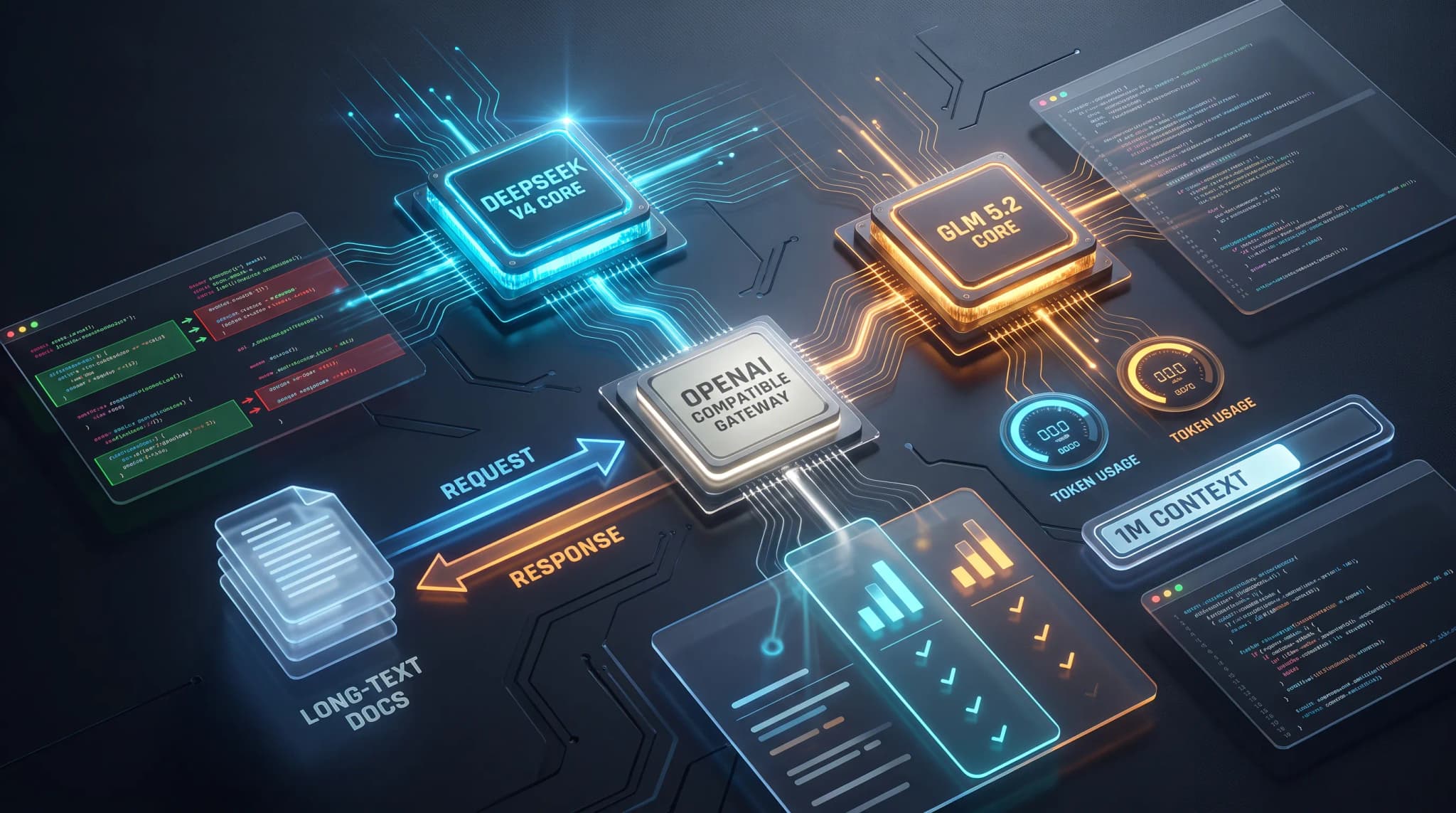
A deepseek v4 vs glm 5.2 search usually hides one real question: which route
should a production application actually call? Both models are available on
OurToken through the same OpenAI-compatible endpoint, both return the same
Chat Completions response shape, and both bill on a per-million-token basis.
The differences that change a buying decision are context window, coding
behavior, long-text handling, and price — not the request format.
This guide compares the two on the dimensions that affect a real integration: endpoint and model ID, current pricing against the official list price, context window, coding and long-context workflows, and a cost model for a typical workload. For each dimension I state what is verified on the live OurToken model pages and what is a documented positioning claim you should confirm on your own data. It is a capability and cost comparison, not a benchmark claim — I do not have independent benchmark numbers, so I use each model's documented positioning and OurToken's listed prices, and flag where you should run your own test before committing traffic. Both routes are verified against the live OurToken model pages on July 27, 2026, and all prices below come from those pages.
Verification status: Pricing, endpoint, model ID, and context facts are verified against the live OurToken model pages. Capability descriptions follow each model's documented positioning. I did not run a head-to-head benchmark; treat the coding and long-context sections as a decision framework, and validate on your own workload before committing production traffic.
Same Gateway, Different Routes
The first thing to settle is that this is not a migration. DeepSeek V4 and GLM 5.2 run on the same OurToken gateway with the same request contract:
Base URL:     https://api.ourtoken.ai/v1
Full URL:     https://api.ourtoken.ai/v1/chat/completions
Auth header:  Authorization: Bearer YOUR_API_KEY
The only value that changes between the two is the model field. DeepSeek V4
ships as two routes — deepseek-v4-pro and deepseek-v4-flash — while GLM 5.2
is a single glm-5.2 route. The OpenAI Python SDK, cURL, and any
OpenAI-compatible client work against both unchanged; switching is a one-line
model-id change. The DeepSeek V4 API key setup guide
and the GLM 5.2 API key setup guide
cover the per-model configuration in detail.
Exact values to copy
| Setting | DeepSeek V4 Pro | DeepSeek V4 Flash | GLM 5.2 |
|---|---|---|---|
| Model ID | deepseek-v4-pro | deepseek-v4-flash | glm-5.2 |
| Endpoint | /v1/chat/completions | /v1/chat/completions | /v1/chat/completions |
| Usage fields | prompt_tokens / completion_tokens / total_tokens | same | same |
| Official price share | 80% of official | 80% of official | 60% of official |
All three return the standard Chat Completions usage object. When cache details
are present, prompt_tokens_details.cached_tokens is a breakdown of the prompt
total, not a second full input quantity — do not double-count it in cost math.
The prompt caching guide
explains how to read those fields correctly.
Pricing and Cost Model
Both models are priced per million tokens and listed against the official provider price. The numbers below are the current OurToken listings checked on July 27, 2026; confirm the live DeepSeek V4 Pro pricing and the live GLM 5.2 pricing before setting a budget.
| Token category | DeepSeek V4 Pro (Official / OurToken) | DeepSeek V4 Flash (Official / OurToken) | GLM 5.2 (Official / OurToken) |
|---|---|---|---|
| Input | $0.435 / $0.3480 per 1M | $0.14 / $0.1120 per 1M | $1.40 / $0.8400 per 1M |
| Output | $0.87 / $0.6960 per 1M | $0.28 / $0.2240 per 1M | $4.40 / $2.6400 per 1M |
| Cached input | $0.003625 / $0.0030 per 1M | $0.0028 / $0.0020 per 1M | $0.26 / $0.1560 per 1M |
| Cache writes | $0 / $0 per 1M | $0 / $0 per 1M | $0 / $0 per 1M |
Two things stand out. DeepSeek V4 is roughly an order of magnitude cheaper than GLM 5.2 on raw input and output, and its cached-input rate is a fraction of a cent — caching pays off hardest on the DeepSeek route. GLM 5.2 is priced at 60% of the official list price (a deeper discount than DeepSeek's 80%), but its absolute per-token cost is still higher because the official GLM price is higher.
Worked cost example. Take a coding-assistant request with 50,000 input tokens and 4,000 output tokens, run on each route at OurToken prices:
DeepSeek V4 Pro:
  Input:   50,000 / 1,000,000 * $0.3480 = $0.017400
  Output:   4,000 / 1,000,000 * $0.6960 = $0.002784
  Total:                                = $0.020184

DeepSeek V4 Flash:
  Input:   50,000 / 1,000,000 * $0.1120 = $0.005600
  Output:   4,000 / 1,000,000 * $0.2240 = $0.000896
  Total:                                = $0.006496

GLM 5.2:
  Input:   50,000 / 1,000,000 * $0.8400 = $0.042000
  Output:   4,000 / 1,000,000 * $2.6400 = $0.010560
  Total:                                = $0.052560
On that workload GLM 5.2 costs about 2.6x DeepSeek V4 Pro and about 8x DeepSeek
V4 Flash. With a cached 50,000-token prefix, the GLM 5.2 line drops to roughly
$0.00780 + $0.01056 = $0.01836, and the DeepSeek V4 Pro line drops to roughly
$0.00015 + $0.002784 = $0.002934 — caching narrows but does not close the gap.
The decision is rarely "cheapest wins"; it is "does the more expensive route
produce output that saves enough downstream cost or rework to justify the
difference?"
Context Window and Capability Positioning
The models are positioned for overlapping but distinct workloads, and the context window is the cleanest dividing line.
GLM 5.2 is documented on the OurToken model page as a 1M-token context route ("1M-context evaluation according to supplied launch material") aimed at coding workflows, long-horizon work, and production assistant tasks. GLM 5.2 is Z.ai's open-weights coding model released under an MIT license; see the official GLM model page on Z.ai for the weights, license, and framework support. The 1M window is the differentiator: it lets one request carry a large repository diff plus test output, or a long document, without truncation or multi-turn stitching.
DeepSeek V4 Pro is positioned on OurToken as the higher-capability DeepSeek route for "reasoning, coding, chat, and production assistant workloads." DeepSeek V4 Flash is positioned as the cost-efficient route for "chat, coding, summarization, long-context prompts, and high-volume assistant workloads." The OurToken model pages do not print an explicit context number for the DeepSeek routes, so confirm the current context limit on the live DeepSeek API documentation before sending a very large prompt. Do not assume the DeepSeek route matches GLM 5.2's 1M window.
The practical implication: if your workload is "summarize or reason over a document that fits in a few hundred thousand tokens," either route can serve it and price should decide. If your workload is "put an entire large codebase or very long document in one prompt," GLM 5.2's documented 1M window is the safer choice until you verify the DeepSeek route's actual limit.
When to pick which
| Your workload | Lean toward | Why |
|---|---|---|
| Large codebase or long doc in a single prompt | GLM 5.2 | Documented 1M context window |
| High-volume chat / classification / summarization | DeepSeek V4 Flash | Lowest absolute cost, positioned for volume |
| Reasoning-heavy coding where output quality matters most | DeepSeek V4 Pro | Higher-capability route, still far cheaper than GLM 5.2 |
| Repeat-prompt agentic loops with stable prefixes | DeepSeek V4 Pro/Flash | Sub-cent cached-input rate compounds across calls |
| You need open weights to self-host | GLM 5.2 | MIT-licensed weights on Hugging Face |
This is a routing decision, not a loyalty decision. A common production pattern is to send high-volume simple work to DeepSeek V4 Flash, reserve DeepSeek V4 Pro for reasoning steps, and use GLM 5.2 only when a single request needs the full 1M context. The model routing guide describes how to implement that split with one gateway and per-task model selection.
Run the Same Prompt on Both Routes
The fastest way to settle which model fits your task is to send one real prompt to both and compare output, latency, and cost. Because the routes share an endpoint, this is a loop over model IDs, not two integrations:
import os

from openai import OpenAI


client = OpenAI(
    api_key=os.environ["OURTOKEN_API_KEY"],
    base_url="https://api.ourtoken.ai/v1",
)

prompt = [
    {"role": "system", "content": "You are a senior software engineer. Review the diff and list risks."},
    {"role": "user", "content": "<paste your real diff and test output here>"},
]

for model in ("deepseek-v4-pro", "deepseek-v4-flash", "glm-5.2"):
    response = client.chat.completions.create(
        model=model,
        messages=prompt,
        max_tokens=1024,
    )
    usage = response.usage
    print(
        model,
        "| tokens in/out:",
        usage.prompt_tokens,
        usage.completion_tokens,
        "| finish:",
        response.choices[0].finish_reason,
    )
    # store each response and compare output quality + cost offline
Run this on three or four of your real prompts — not synthetic ones — and record the token counts, latency, and whether the output needed editing. The model with the lowest token cost is not always the model with the lowest total cost: a cheaper route that produces output requiring a human rework pass can be more expensive than a pricier route that is correct the first time.
Multi-turn and tool calls. Both routes are stateless Chat Completions, so
send the conversation history on each turn. When tools are involved, preserve
the complete assistant message — including tool_calls — instead of storing
only content, and keep each tool result's tool_call_id matched to its call.
The tool-calling guide
covers the message pattern that keeps multi-turn tool loops consistent across
OpenAI-compatible routes, including DeepSeek and GLM.
Coding and long-text workflows
For a code-review or long-document task, keep these rules the same regardless of which route you call:
- Keep the review policy and repository instructions in a stable system prompt so the prefix is cacheable.
- Send only the relevant diff or document section, not the whole repository, unless you are deliberately testing the GLM 5.2 1M window.
- Bound
max_tokensso a malformed prompt cannot create an unbounded bill. - Validate paths, commands, and structured output before acting on model output; never let a model directly modify a repository without human approval.
- Record model, status, latency, and token usage per request so you can attribute cost to the route that produced it.
If you are building a retrieval pipeline on top of either model, the OpenAI-compatible API for RAG guide shows how to route embeddings, reranking, and synthesis to different models through one endpoint without rewriting the synthesis call when you swap DeepSeek for GLM.
Reliability and production notes.
Comparing two routes also means comparing how they fail. Both return the same HTTP status semantics on the OurToken gateway, so one retry policy covers both:
| Status | Retry by default? | Action |
|---|---|---|
| 400 | No | Fix the body or remove an unsupported field |
| 401 | No | Replace or reconfigure the credential |
| 404 | No | Check the base URL, path, and model ID |
| 429 | Yes, bounded | Back off and respect account limits |
| 500-599 | Yes, bounded | Retry with a maximum attempt count |
| Network timeout | Conditional | Retry only when duplicate execution is safe |
Two production cautions specific to a two-route setup. First, do not fall back from a 400/401/404 on one model to the other unchanged — those are configuration errors, and silently routing a broken request to a different model hides the real problem. Second, when you use model routing to send work to the cheaper route by default, keep an allowlist on the server rather than accepting an arbitrary model string from an untrusted client, so a client cannot force the pricier GLM 5.2 route and inflate the bill.
Conclusion and Frequently Asked Questions
DeepSeek V4 and GLM 5.2 are not competing formats — they are two model routes on one OpenAI-compatible gateway. Pick by workload, not by habit: DeepSeek V4 Flash for high-volume low-cost work, DeepSeek V4 Pro for reasoning-heavy steps, and GLM 5.2 when a single request needs the documented 1M-token context window. Verify the choice on your own prompts with the side-by-side script above before moving production traffic.
When you are ready to test either route with a real credential, review the DeepSeek V4 Pro model configuration and the GLM 5.2 model configuration, then create a key through the OurToken API Keys page.
FAQ
Which is cheaper, DeepSeek V4 or GLM 5.2?
On OurToken list prices, DeepSeek V4 is much cheaper per token. At 50,000 input and 4,000 output tokens, DeepSeek V4 Flash costs about $0.0065, DeepSeek V4 Pro about $0.020, and GLM 5.2 about $0.053. GLM 5.2 has a deeper percentage discount (60% vs 80% of official), but its official base price is higher.
Do DeepSeek V4 and GLM 5.2 use the same endpoint?
Yes. Both use https://api.ourtoken.ai/v1/chat/completions with
Authorization: Bearer. Only the model field differs: deepseek-v4-pro,
deepseek-v4-flash, or glm-5.2.
Which has a larger context window?
GLM 5.2 is documented on OurToken as a 1M-token context route. The OurToken DeepSeek V4 pages do not print an explicit context number, so confirm the current DeepSeek context limit on the official DeepSeek API docs before sending a very large prompt.
Which is better for coding?
It depends on the task. DeepSeek V4 Pro is positioned as the higher-capability reasoning and coding route; GLM 5.2 is positioned for coding workflows with a 1M window. For most coding prompts that fit well under either limit, run the side-by-side script on your own diffs and compare output quality and cost.
Can I switch between them without changing code?
Yes. Because both are OpenAI-compatible Chat Completions routes on the same
base URL, switching is a one-line model value change. The OpenAI Python SDK,
cURL, and any OpenAI-compatible client work against both unchanged.
Should I cache prompts on both routes?
Yes, but the payoff differs. DeepSeek V4's cached-input rate is a fraction of a cent per million tokens, so caching compounds aggressively across repeat-prompt agentic loops. GLM 5.2's cached-input rate is higher in absolute terms but still well below its uncached input rate, so caching helps on stable long prefixes.