AI Gateway Explained: Architecture, Benefits, and How to Build One in 2026
Learn what an AI Gateway is, how it works, why developers use AI Gateways to reduce costs and manage multiple LLM providers, and how to build an OpenAI-compatible AI Gateway in 2026.
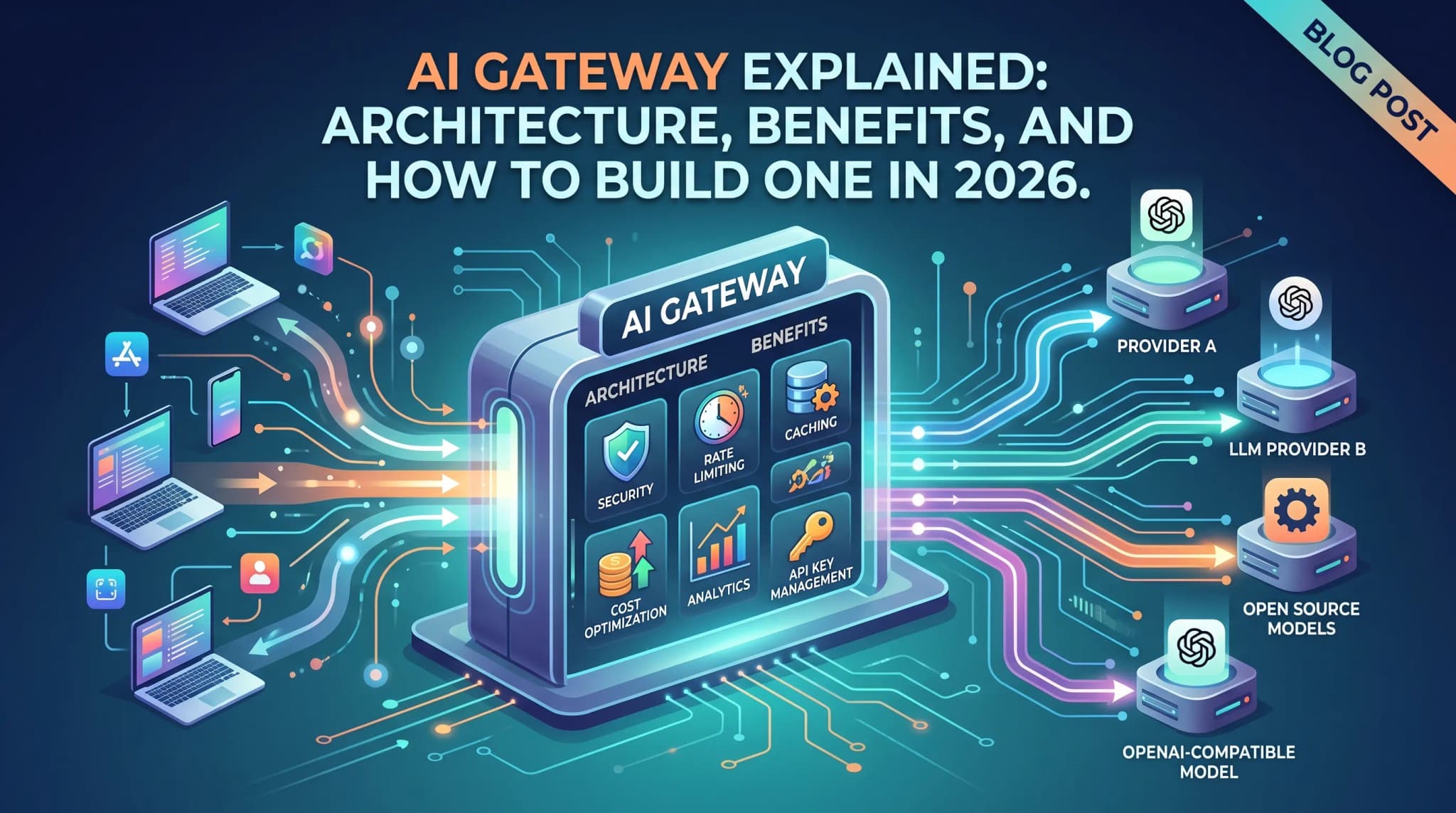
Artificial intelligence infrastructure has evolved rapidly over the past two years. Instead of relying on a single model provider, modern AI applications increasingly connect to multiple large language models (LLMs), image models, and reasoning models simultaneously.
As this ecosystem becomes more complex, one infrastructure component has become increasingly important:
The AI Gateway.
Whether you're building an AI coding assistant, an enterprise chatbot, a SaaS product, or an autonomous AI agent, an AI Gateway can dramatically simplify integrations while reducing operational costs.
In this guide, you'll learn:
- What an AI Gateway is
- Why developers use AI Gateways
- How AI Gateways work
- Key features every gateway should provide
- AI Gateway architecture
- Best practices for implementation
- How OurToken can simplify AI infrastructure
What Is an AI Gateway?
An AI Gateway is a centralized layer between your application and one or more AI model providers.
Instead of integrating directly with every provider, your application communicates with a single endpoint. The gateway is responsible for routing requests, authenticating users, managing usage, applying policies, logging requests, and selecting the appropriate model.
Rather than changing application code every time you add a new provider, the gateway abstracts provider-specific APIs behind a unified interface.
This architecture is becoming common among companies that use multiple AI providers in production.
Why Developers Need an AI Gateway
As organizations adopt more AI models, several operational challenges emerge.
Multiple APIs
Each provider has different endpoints, authentication methods, request formats, streaming implementations, and rate limits.
Maintaining separate integrations quickly becomes difficult.
An AI Gateway provides a single integration point for every supported model.
Rising API Costs
Production AI workloads can become expensive.
Different providers often offer better pricing or performance depending on the task.
A gateway allows intelligent routing so applications can use the most cost-effective model without changing application logic.
High Availability
Every AI provider experiences occasional outages or degraded performance.
Without a gateway, applications fail whenever a provider becomes unavailable.
An AI Gateway can automatically retry requests or fail over to another compatible model.
Unified Monitoring
Instead of collecting logs from several vendors, developers can monitor every AI request from one location.
Typical metrics include:
- Latency
- Token usage
- Request volume
- Model utilization
- Error rates
- Cost per request
This visibility is especially valuable for production systems.
AI Gateway Architecture
A modern AI Gateway typically consists of the following layers.
                Application
                     │
                     ▼
              +----------------+
              |   AI Gateway   |
              +----------------+
              | Authentication |
              | API Keys       |
              | Model Routing  |
              | Load Balancer  |
              | Cost Control   |
              | Logging        |
              | Rate Limiting  |
              | Analytics      |
              +----------------+
                     │
                     ▼
    +---------------------------------------+
    |          AI Model Providers           |
    +---------------------------------------+
    | OpenAI                               |
    | Anthropic                            |
    | Google                               |
    | GLM                                  |
    | DeepSeek                             |
    | MiniMax                              |
    | More Providers...                    |
    +---------------------------------------+
The application only communicates with the gateway.
The gateway manages every interaction with external AI providers.
Core Features of an AI Gateway
Unified API
One API for every supported provider.
This greatly reduces engineering complexity.
Intelligent Model Routing
Gateways can automatically select models based on:
- Latency
- Pricing
- Quality
- Availability
- Context Window
- Enterprise Policies
Rate Limiting
Prevent abuse by limiting requests per user, organization, or API key.
Authentication
Centralized authentication simplifies security and credential management.
Analytics
A production gateway should provide dashboards showing:
- Total requests
- Token consumption
- Daily spending
- Most-used models
- Error trends
Cost Optimization
One of the biggest advantages is optimizing AI spending.
For example:
- Expensive reasoning tasks → Premium models
- Lightweight summarization → Lower-cost models
- Fallback providers during traffic spikes
This strategy can significantly reduce infrastructure costs without sacrificing user experience.
AI Gateway vs Traditional API Gateway
| Feature | Traditional API Gateway | AI Gateway |
|---|---|---|
| Authentication | ✅ | ✅ |
| Rate Limiting | ✅ | ✅ |
| Routing | Basic | AI-aware |
| Cost Optimization | ❌ | ✅ |
| Model Selection | ❌ | ✅ |
| Token Tracking | ❌ | ✅ |
| LLM Analytics | ❌ | ✅ |
| Provider Failover | Limited | ✅ |
| AI Policy Enforcement | ❌ | ✅ |
An AI Gateway extends the capabilities of a traditional API gateway with AI-specific routing, observability, and optimization features.
Best Practices for Building an AI Gateway
When designing an AI Gateway for production, consider these recommendations:
- Keep the API interface consistent across providers.
- Separate authentication from routing logic.
- Implement provider failover and retry strategies.
- Monitor latency, token usage, and costs in real time.
- Support streaming responses for chat applications.
- Add request logging and audit trails for enterprise deployments.
- Use configurable routing rules so models can be swapped without changing application code.
How OurToken Fits Into an AI Gateway Strategy
For teams that want the benefits of an AI Gateway without maintaining integrations with multiple providers, OurToken offers an OpenAI-compatible API platform designed for modern AI applications.
Developers can access multiple leading AI models through a single API while keeping integration changes minimal.
Supported Models
- GPT-5.5
- GPT-5.4
- GPT-5.4-mini
- Claude Opus 4.8
- Claude Opus 4.7
- Claude Opus 4.6
- Claude Sonnet 4.6
- GLM 5.2
- GLM 5.1
Why Developers Choose OurToken
- OpenAI-compatible API
- One API for multiple providers
- Prepaid pay-as-you-go billing
- Lower API costs than many official providers
- Fast integration with existing OpenAI SDKs
Conclusion
AI Gateways are becoming a foundational layer of modern AI infrastructure. As organizations adopt multiple LLM providers, a gateway helps reduce engineering complexity, improve reliability, optimize costs, and centralize observability.
Whether you're building an AI agent, coding assistant, enterprise SaaS product, or customer support platform, investing in an AI Gateway architecture today can make your AI stack more scalable and easier to manage as the ecosystem continues to evolve.
Learn More
If you're looking for an OpenAI-compatible AI Gateway with access to multiple leading models through a single API, explore OurToken and start building with one unified integration.